
Polyaspartic vs Epoxy: Which Floor Coating Wins?
Polyaspartic coating is defined as a polyaspartic ester resin that cures faster, flexes more, and resists UV degradation better than traditional epoxy. For Colorado homeowners and commercial property managers weighing polyaspartic vs epoxy, the performance gap is real and measurable. Polyaspartic coatings last 15–20+ years compared to epoxy’s 5–10 years in residential garages. They also cure fast enough to allow foot traffic in as little as one hour. Understanding these differences upfront saves you from a costly re-coat cycle down the road.
What are polyaspartic and epoxy coatings, and how do their chemistries differ?
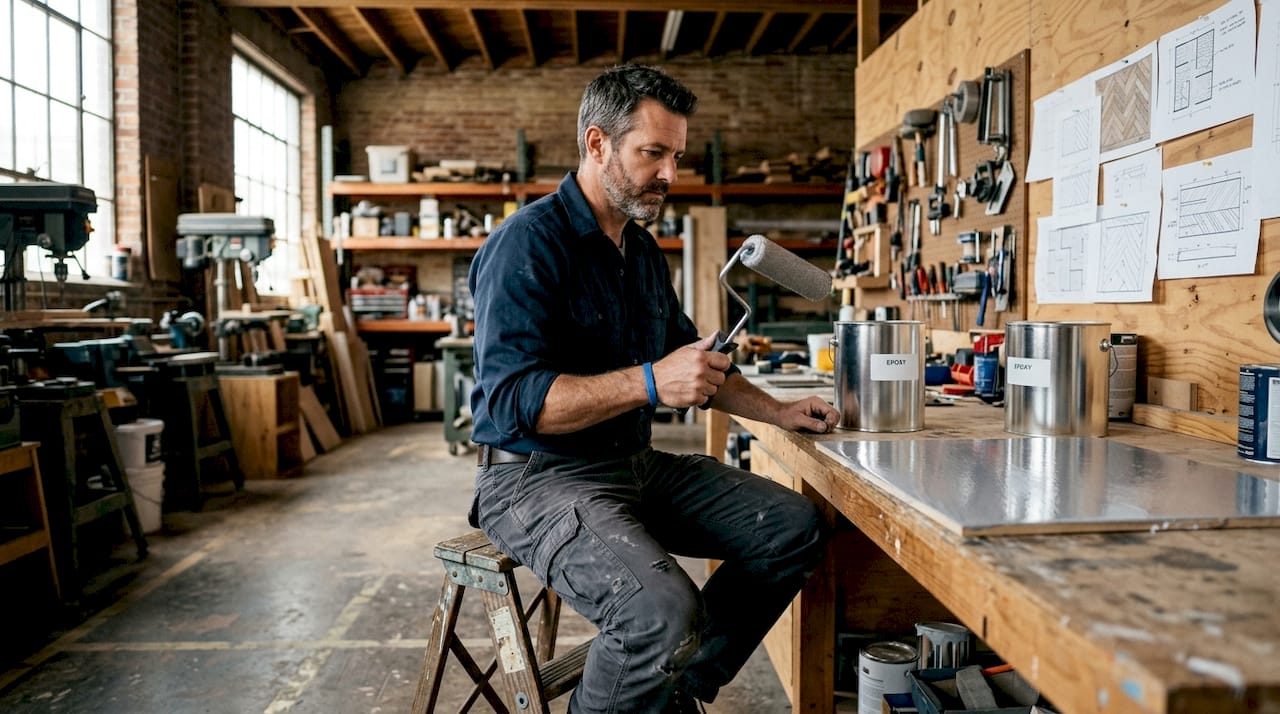
Epoxy is a thermoset resin. It cures through a chemical reaction between a resin and a hardener, producing a rigid, plastic-like film that bonds tightly to concrete. That rigidity is both its strength and its weakness. Epoxy resists heavy loads well, but it does not flex when the concrete beneath it expands and contracts with temperature changes.
Polyaspartic is a type of polyurea chemistry. Specifically, it is a polyaspartic ester formed by reacting a diamine with a diethyl maleate. The result is a coating with elongation at break rates of 100–400%, meaning it stretches and recovers rather than cracking. That flexibility makes it far better suited to Colorado’s freeze-thaw cycles and wide temperature swings.
The two chemistries also differ in UV behavior. Epoxy contains aromatic compounds that break down under ultraviolet light. Polyaspartic uses aliphatic chemistry, which is inherently UV stable. That single molecular difference explains why epoxy yellows and why polyaspartic does not.
Here is how the core chemistry differences break down:
- Cure mechanism: Epoxy uses a two-part resin-hardener reaction; polyaspartic uses a faster aliphatic polyurea reaction
- Flexibility: Epoxy is rigid; polyaspartic has high elongation at break, allowing movement with the substrate
- UV stability: Epoxy degrades under sunlight; polyaspartic is aliphatic and inherently UV resistant
- Moisture tolerance: Epoxy handles moisture better as a primer; polyaspartic cures too fast to penetrate deeply as a moisture barrier
- Pot life: Epoxy gives you more working time; polyaspartic has a short pot life requiring fast, skilled application
Professional installers often combine both chemistries. They apply an epoxy primer first to seal moisture and improve adhesion, then finish with a polyaspartic topcoat for UV resistance and durability. This hybrid approach captures the best of both systems and represents current best practice in the industry.
How do polyaspartic and epoxy compare on durability, UV resistance, and flexibility?
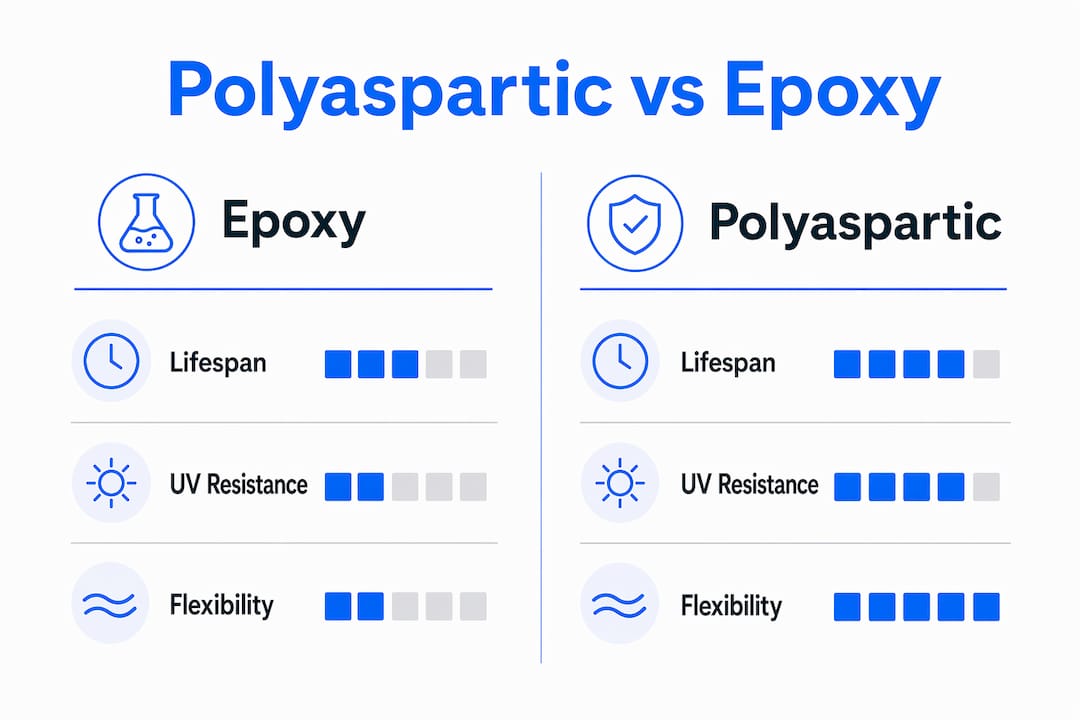
Durability is where the gap between these two coatings becomes impossible to ignore. Epoxy lasts 5–10 years in a typical residential garage. Polyaspartic coatings routinely last 15–20+ years under the same conditions. That difference compounds over time because every re-coat cycle costs money, time, and disruption.
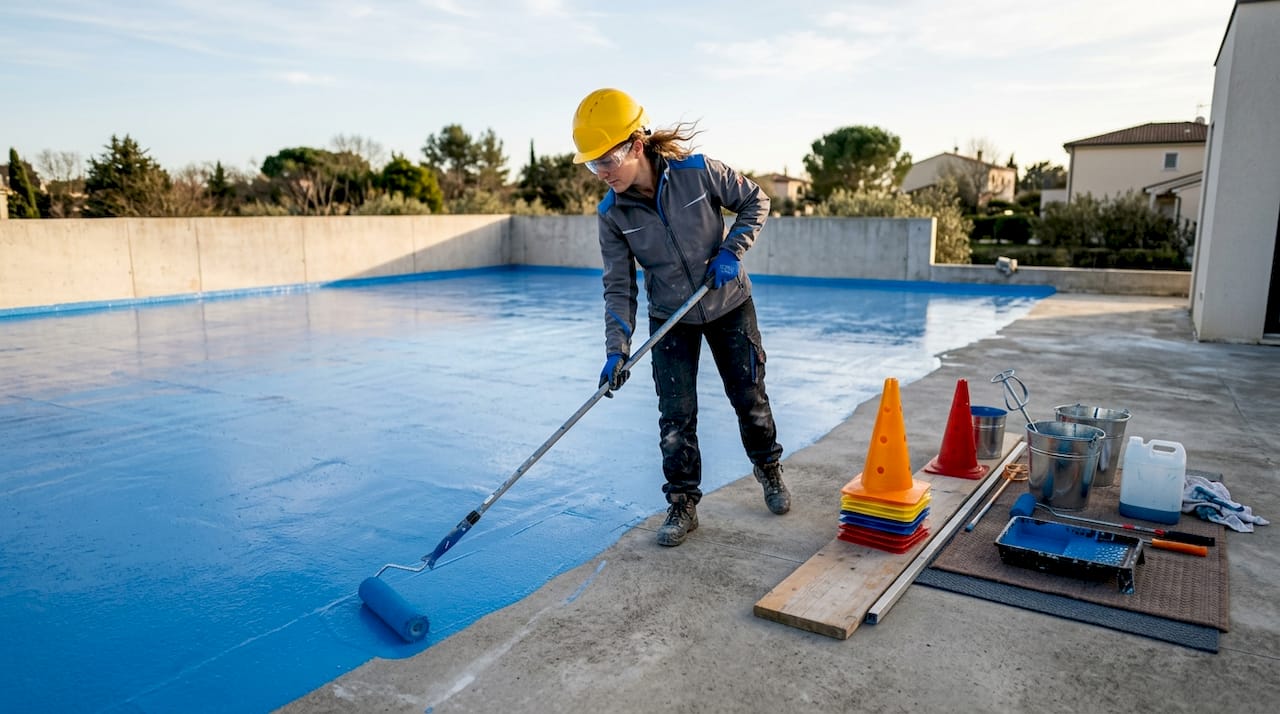
UV resistance is a decisive factor for any Colorado garage or commercial space with natural light exposure. Epoxy yellows within 1–3 years when exposed to sunlight. Polyaspartic coatings do not yellow at all. For property managers who care about long-term appearance, that is not a minor detail. It is the difference between a floor that looks sharp for two decades and one that looks stained within a few years.
Flexibility matters more in Colorado than in most states. Denver and Colorado Springs both experience dramatic temperature swings between seasons and even within a single day. Epoxy’s rigidity makes it vulnerable to cracking when concrete expands and contracts. Polyaspartic absorbs those stresses without delaminating or peeling.
| Performance Factor | Epoxy | Polyaspartic |
|---|---|---|
| Lifespan | 5–10 years | 15–20+ years |
| UV resistance | Yellows in 1–3 years | Inherently stable, no yellowing |
| Flexibility | Rigid, prone to cracking | 100–400% elongation at break |
| Hot tire resistance | Moderate | High |
| Chemical resistance | Good | Excellent |
| Cure time (vehicle ready) | 5–7 days | 24 hours |
Pro Tip: If your garage gets direct afternoon sun through windows or an open door, polyaspartic is the only coating that will hold its color long-term. Epoxy will amber noticeably within two Colorado summers.
What are the differences in installation, cure times, and costs?
Cost is where epoxy appears to win at first glance. Epoxy typically runs $3–$10 per square foot installed. Polyaspartic runs $5–$12 per square foot. On a standard two-car garage of roughly 400 square feet, that gap can mean $800–$1,000 more upfront for polyaspartic. But that upfront number does not tell the full story.
Epoxy’s lower initial cost becomes more expensive over time when you factor in re-coating cycles, maintenance, and repairs. A polyaspartic floor installed once and maintained properly outlasts two or three epoxy jobs. The total cost of ownership over a 15–20 year period favors polyaspartic in most scenarios.
Cure time is the other major installation variable. Polyaspartic allows foot traffic in 1–6 hours and vehicle traffic in 24 hours. Epoxy requires 24–72 hours before light use and up to 5–7 days before you can park a car on it. For a commercial property manager, a week of downtime in a parking structure or warehouse is a real operational cost.
Key installation considerations for both coatings:
- Surface preparation is non-negotiable. Both coatings require clean, profiled concrete. Grinding or shot-blasting opens the surface for proper adhesion.
- Moisture testing matters. Epoxy handles moisture better as a primer layer. High moisture vapor transmission can cause both coatings to delaminate if prep is skipped.
- Temperature affects application. Epoxy needs temperatures above 50°F to cure properly. Polyaspartic can be applied in a wider temperature range, which is a real advantage during Colorado’s shoulder seasons.
- Polyaspartic is not a DIY product. Its short pot life means you have minutes, not hours, to apply it correctly. DIY application is strongly discouraged by professionals because mistakes are difficult to fix once the coating begins to cure.
- Epoxy is more forgiving for DIY. Its longer working time gives inexperienced applicators more room for error, though professional results still require professional prep.
When should you choose polyaspartic over epoxy, and vice versa?
The right coating depends on your specific situation. Polyaspartic wins in most real-world Colorado scenarios, but epoxy has a legitimate place in the right context.
Choose polyaspartic when:
- Your garage or floor gets direct sunlight or UV exposure through windows or doors
- You need the floor back in service fast, whether for a home or a commercial property
- The space experiences wide temperature swings or freeze-thaw cycles
- You want a coating that holds its appearance for 15–20 years without re-coating
- The floor sees heavy vehicle traffic, chemical spills, or abrasive use
Choose epoxy when:
- The space is fully climate-controlled and receives no direct sunlight
- Budget is the primary constraint and long-term re-coating is acceptable
- You are coating an interior basement or utility room with stable temperatures
- You want a DIY-friendly option and are willing to accept a shorter lifespan
Contractors recommend epoxy for indoor, climate-controlled areas where budget is the priority. Polyaspartic is the preferred choice wherever UV exposure, temperature variation, or moisture is a factor. For most Colorado garages, that means polyaspartic wins by default.
The hybrid system is worth serious consideration for any high-performance installation. Epoxy as a moisture-mitigating primer with a polyaspartic topcoat gives you the adhesion and moisture control of epoxy combined with the UV stability and flexibility of polyaspartic. This is the approach most experienced installers use on premium jobs.
Pro Tip: For commercial property managers in Denver, the hybrid system is often the smartest call. You get the durability of polyaspartic on top with the moisture protection of epoxy underneath, and the floor is back in service within 24 hours.
Maintenance expectations also differ. Polyaspartic floors are easier to clean and more resistant to staining. Epoxy floors require more frequent sealing and are more susceptible to surface damage over time. Over a 20-year horizon, the maintenance burden of epoxy adds up in both time and cost.
Key Takeaways
Polyaspartic coatings outperform epoxy on every major performance metric except upfront cost, making them the better long-term investment for most Colorado homeowners and property managers.
| Point | Details |
|---|---|
| Lifespan advantage | Polyaspartic lasts 15–20+ years vs. epoxy’s 5–10 years in residential garages. |
| UV stability | Epoxy yellows within 1–3 years in sunlight; polyaspartic holds its color indefinitely. |
| Flexibility in cold climates | Polyaspartic’s 100–400% elongation at break prevents cracking through Colorado freeze-thaw cycles. |
| Cure time | Polyaspartic allows vehicle traffic in 24 hours vs. 5–7 days for epoxy. |
| Best value system | A hybrid epoxy primer with polyaspartic topcoat delivers maximum durability and UV protection. |
What I’ve learned after seeing hundreds of Colorado garage floors
After working around concrete surfaces across the Denver metro and Colorado Springs for years, one pattern stands out clearly. Homeowners who chose epoxy because it was cheaper almost always come back within five to seven years with a floor that is yellowed, peeling at the edges, or showing stress cracks near the garage door threshold. That threshold area is the first to fail because it sees the most temperature variation.
The coating chemistry debate matters less than most people think. What matters most is surface preparation and installer skill. I have seen polyaspartic fail on floors that were not properly ground and profiled. I have also seen well-applied epoxy hold up decently in a shaded, climate-controlled basement for a decade. The coating is only as good as the prep work underneath it.
The DIY angle is where I see the most costly mistakes. Polyaspartic’s short pot life is not a minor inconvenience. It is a genuine technical challenge. A homeowner who buys a polyaspartic kit and tries to apply it on a warm Colorado afternoon is likely to end up with a streaky, partially cured mess that costs more to fix than a professional installation would have cost in the first place. Epoxy is more forgiving, but even epoxy requires proper diamond grinding and moisture testing to bond correctly.
My honest recommendation for most Colorado property owners is the hybrid system. Pay for professional installation, use an epoxy primer for moisture control, and finish with a quality polyaspartic topcoat. You will not re-coat that floor for 20 years. That is the real value calculation.
— Brandon
Alldaypowerwashing can help you prepare your floor the right way
A floor coating is only as good as the surface beneath it. Contaminated, oily, or improperly cleaned concrete causes both epoxy and polyaspartic coatings to fail prematurely, no matter how good the product is.
Alldaypowerwashing serves homeowners and commercial property managers across the Denver metro area with commercial-grade pressure washing in Denver that removes oil stains, grease, and surface contaminants before coating work begins. A properly cleaned and prepped surface gives your coating installer the best possible foundation to work with. Alldaypowerwashing offers same-week quotes, is fully insured, and backs every job with a satisfaction guarantee. If you are planning a garage floor coating project, start with a clean slate. Reach out to Alldaypowerwashing to get your surface ready.
FAQ
Is polyaspartic better than epoxy for garage floors?
Polyaspartic is better than epoxy for most garage floors because it lasts 15–20+ years, resists UV yellowing, and handles temperature swings without cracking. Epoxy can work in fully shaded, climate-controlled spaces where budget is the primary concern.
How long does polyaspartic coating last compared to epoxy?
Polyaspartic coatings last 15–20+ years in residential garages, while epoxy typically lasts 5–10 years under the same conditions.
Can I apply polyaspartic coating myself?
DIY application of polyaspartic is strongly discouraged because its short pot life requires fast, skilled application. Mistakes are difficult to correct once the coating begins to cure.
What is the difference between polyaspartic and polyurea coatings?
Polyaspartic is a subtype of polyurea chemistry. Both share flexibility and fast cure times, but polyaspartic coatings are specifically formulated for floor applications and offer better UV stability than standard polyurea products.
How much does polyaspartic coating cost compared to epoxy?
Polyaspartic coatings run $5–$12 per square foot installed, while epoxy runs $3–$10 per square foot. Polyaspartic costs more upfront but requires fewer re-coats over its lifespan, making it more cost-effective over 15–20 years.