Pass a U.S. Hood Inspection: Two Minute ASR File for Hood Cleaning
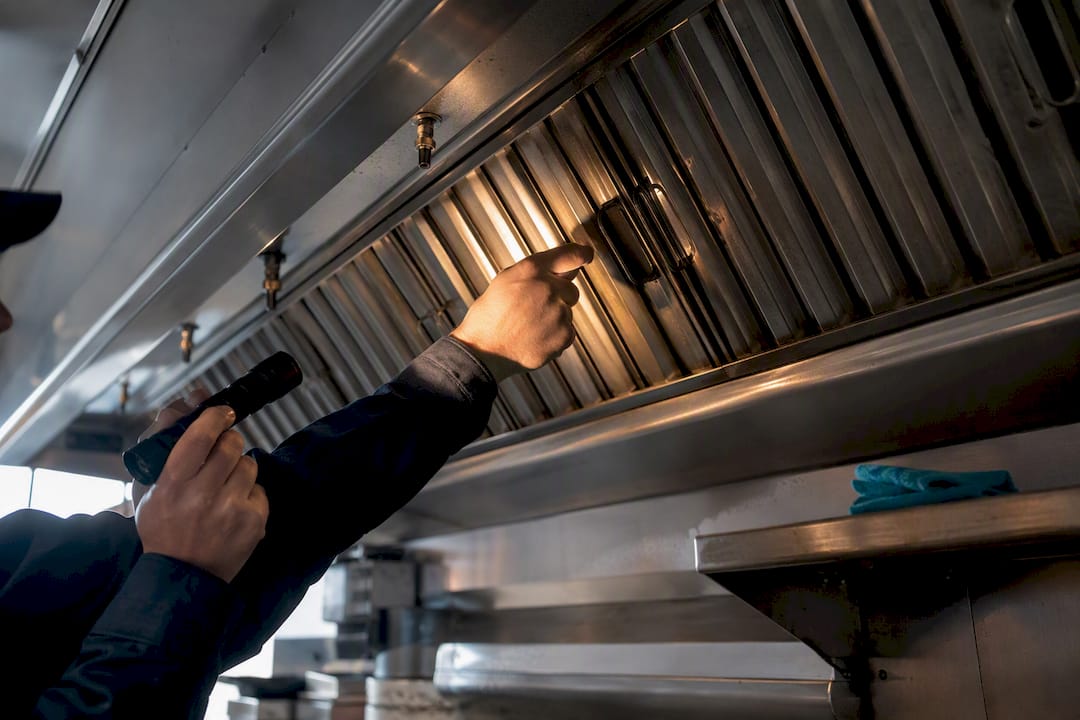
A clean-looking hood does not pass an inspection. What satisfies a U.S. health or fire inspector is a dated, full-system cleaning documented with an After Service Report, time-stamped before-and-after photos, and a visible service sticker on the hood itself. NFPA 96 sets the baseline every Authority Having Jurisdiction (AHJ) or fire marshal measures against, and your local code can demand more.
TL;DR:
- Full-system cleaning documentation must include a detailed report, timestamped photos, and a visible service sticker to satisfy inspectors’ recordkeeping standards.
- NFPA 96 requires cleaning the entire exhaust system, including ducts and rooftop fan, with frequency based on kitchen grease production, not a set schedule.
- Inspectors scrutinize every component, especially duct interiors and access panels, and will verify cleanliness through direct inspection rather than trust in visual appearance alone.
- Having a complete, signed, and photo-documented After Service Report ready on-site is essential to passing inspections and avoiding costly corrective orders.
- Certified professionals, with industry-standard training and proper documentation, are the only reliable choice for full-system hood cleaning that meets regulatory requirements.
Table of Contents
- Health Inspection Hood Cleaning Checklist: What To Have Ready
- What Does NFPA 96 Actually Require?
- How Often Should You Clean Your Hood System?
- What Do Inspectors Actually Look At Inside the Hood System?
- How Do You Build a Hood-Cleaning File That Actually Holds Up?
- Who Is Actually Qualified To Clean Your Hood System?
- Getting Your Kitchen Ready the Day an Inspector Walks In
- What Happens When a Hood Inspection Fails?
- What a Documented Hood Cleaning Actually Looks Like
- What Most Operators Get Wrong About Compliance
- Get a Documented, Full-System Hood Cleaning Booked
- Where to Verify These Standards Yourself
- Sources
Health Inspection Hood Cleaning Checklist: What To Have Ready
Inspectors move fast, and they know exactly what a compliant kitchen looks like on paper. Keep a single file, physical or digital, that an inspector can flip through in under two minutes.
Your on-site file should include:
- The most recent After Service Report (ASR) with technician name and date
- The paid invoice matching that ASR
- Before-and-after photos with visible timestamps
- The physical service sticker or tag on the hood
- Direct contact info for the vendor who performed the work
Confirm the ASR covers the full system, not just the parts you can see: hood canopy, grease filters, plenum, duct runs, access panels, and the rooftop fan. If any section was skipped, the report should say why and when it gets addressed.
On the day of inspection, walk the inspector straight to the hood sticker and hand over the file before they ask. If a question comes up about a section you cannot answer, call your vendor while the inspector is still on-site. A five-minute phone call that clears up a duct question beats a follow-up visit and a corrective order.
What Does NFPA 96 Actually Require?
NFPA 96 is the national standard for ventilation control and fire protection in commercial cooking operations, and it’s the document your local fire marshal is quietly checking you against even when they never say its name out loud. It sets expectations for how thoroughly a system gets cleaned, how often, and what records need to exist afterward.
The standard doesn’t just cover visible grease. It expects the entire exhaust path, from the hood down through the duct and out to the rooftop fan, to reach a level of cleanliness where no combustible residue remains. That’s the line AHJs use when they decide whether a “cleaned” system actually passed.
Local fire codes typically adopt NFPA 96 by reference, then layer on their own interpretation. Some jurisdictions add stricter recordkeeping rules or require specific certifications for anyone performing the work, as Massachusetts does under its commercial cooking exhaust system inspection program. Never assume the national standard is the ceiling. Check your city and county fire code before you assume you’re covered, because AHJ requirements can, and often do, exceed NFPA 96’s minimums.
How Often Should You Clean Your Hood System?
NFPA 96 ties cleaning frequency to how much grease your kitchen actually produces, not a flat calendar rule. Get the frequency wrong and you’ll either waste money over-cleaning or walk into an inspection with buildup nobody expected.
The standard intervals break down by cooking volume:
NFPA 96 ties cleaning frequency to cooking volume, recommending more frequent cleanings for higher volume operations and less frequent for lower volume, without specifying exact monthly intervals.
Those intervals are the floor, not a guarantee. Visible grease dripping from the filters, a spike in fried menu items, smoke complaints from neighbors, or a failed prior inspection all justify moving up a tier immediately. A kitchen that added a wok station last quarter but is still on its six-month schedule is overdue, even if the calendar says otherwise.
Frequency matters for two separate inspectors with two separate concerns. Fire officials care about ignition risk building up in the duct. Health inspectors care about grease migrating onto food-contact surfaces and creating a sanitation problem. One cleaning schedule has to satisfy both.
What Do Inspectors Actually Look At Inside the Hood System?
Inspectors don’t stop at the canopy. Each component gets its own scrutiny, and the parts you can’t see from the kitchen floor tend to cause the most trouble.
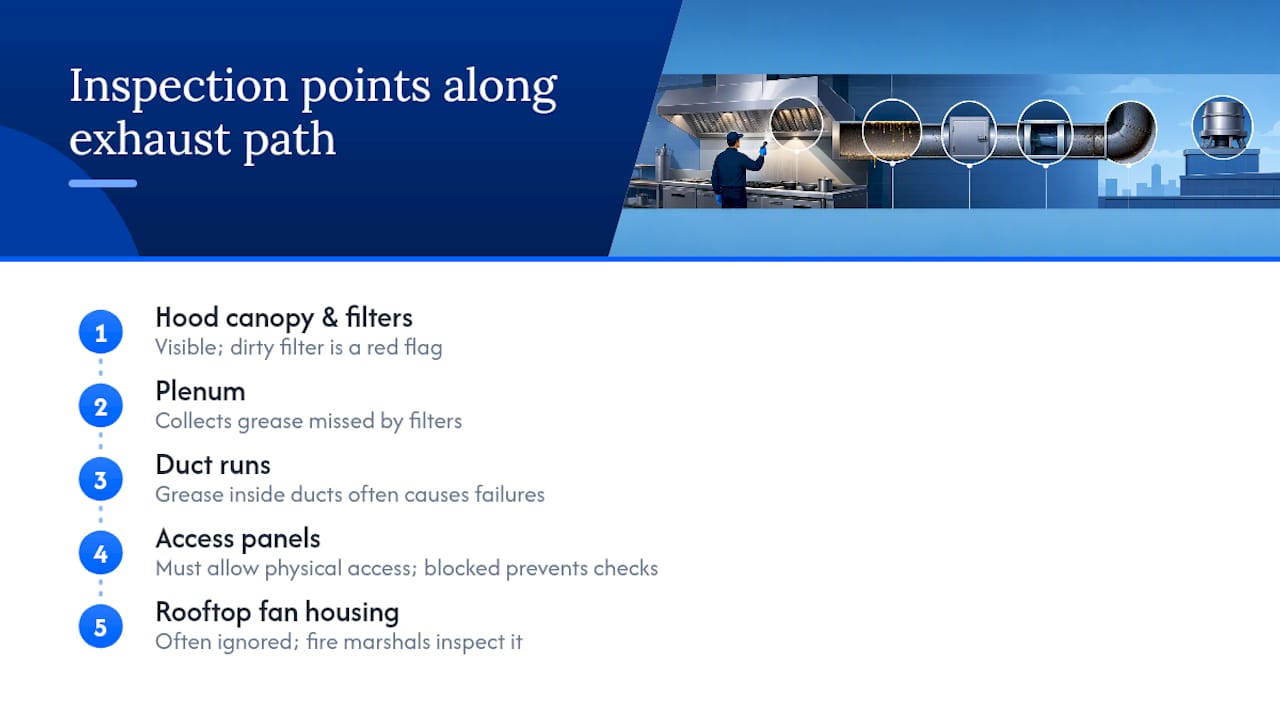
Hood canopy and grease filters get the first look, since they’re visible and easy to check. A dirty filter is an obvious red flag, but a spotless filter can mask what’s happening upstream.
The plenum, the chamber behind the filters, collects grease that filters miss. Inspectors trained on NFPA 96 know to check it directly rather than trust a clean-looking canopy.
Duct runs are where the real risk hides. A common finding among failed inspections is heavy grease accumulation inside duct interiors that surface-only services never touch. A clean filter and a filthy duct can exist in the same kitchen.
Access panels matter because inspectors need to physically verify duct cleanliness, not take your word for it. Panels that are welded shut, blocked by equipment, or missing entirely are a documented barrier, and inspectors will ask why nobody’s fixed that.
The rooftop fan housing rounds out the checklist. It’s easy to ignore because almost nobody climbs up there, which is exactly why fire marshals do.
How Do You Build a Hood-Cleaning File That Actually Holds Up?
A sticker on the hood tells an inspector a cleaning happened. It doesn’t tell them what got cleaned, and relying on a sticker alone is one of the most common gaps operators don’t realize they have until an inspector asks for the full report.
A defensible After Service Report needs these fields at minimum:
- Date of service and technician name
- Full scope of work performed, system by system
- Explicit notes on any area not cleaned, with a reason and a remediation timeline
- Deficiencies found, however minor
- Time-stamped signatures from both technician and manager on duty
Photo documentation is what actually proves the scope was performed, and checklist guidance from fire protection specialists recommends a specific set: hood canopy, plenum, multiple points along the duct interior, access panel interiors, fan housing, and rooftop, each shot before and after. Our Colorado hood cleaning documentation guide walks through what that photo set looks like in practice.
Keep two copies. A physical binder on-site for the inspector who walks in unannounced, and a cloud backup in case the binder gets lost, damaged, or left in a manager’s car on their day off.
Pro Tip: If any area gets marked “inaccessible” on your report, don’t accept that word alone. Ask the vendor exactly what’s blocking access and get a written date for when it gets fixed. “Inaccessible” without a plan reads to an inspector like a cleaning that didn’t happen.
Who Is Actually Qualified To Clean Your Hood System?
Anyone with a pressure washer can call themselves a hood cleaner. Not everyone should be trusted with your fire code compliance.
Look for these credentials before you hire:
- IKECA certification, which trains technicians on grease-comb measurement and documented cleaning processes under industry standard ANSI C-10
- NFPA-aligned training specific to commercial kitchen exhaust systems
- A state or local certificate of competency, which some jurisdictions require by law
Before signing anything, ask the vendor directly: Do you photograph access panels? Do you clean the full system or just filters and canopy? Are you insured for rooftop work? A vendor who hesitates on any of those answers is telling you something.
Watch for red flags in the paperwork itself. A report with no photos, vague language like “cleaned as needed,” or a scope that only mentions “filters” is a sign the duct and fan never got touched at all.
Getting Your Kitchen Ready the Day an Inspector Walks In
Most failed inspections aren’t about dirty equipment. They’re about missing paperwork for work that actually happened.
Before an inspection, or ideally as a standing habit:
- Keep the ASR and photo set in a folder you can hand over in seconds
- Unlock every access panel ahead of time, don’t make the inspector wait on a maintenance call
- Confirm rooftop access is clear and safe to reach
- Have your vendor’s phone number saved somewhere the whole management team can find it
When the inspector asks a question, answer with the document, not a guess. Point to the specific line in the ASR rather than explaining from memory.
If you discover your file is incomplete mid-inspection, say so directly and request a full report from your vendor immediately. Schedule a full-system cleaning if one hasn’t happened recently, and keep a written record of every call and email with the vendor from that point forward. Inspectors respond better to an operator actively fixing a gap than one pretending it doesn’t exist.
What Happens When a Hood Inspection Fails?
The most common citations trace back to duct grease buildup, missing or expired service tags, and access panels that were never opened for verification. Each one triggers a corrective order with a deadline, and repeat failures can escalate to a shutdown of cooking operations until the system passes.
Insurance is the part operators underestimate. After a grease fire, insurers scrutinize your maintenance history before paying a claim, and a thin or missing paper trail gives them grounds to deny coverage or reduce a payout. A documented, recurring cleaning schedule with reports on file is the single best protection you can build before you ever need it.
What a Documented Hood Cleaning Actually Looks Like
Every After Service Report (ASR) should list the date, technician, full system scope, and any area flagged for follow-up, with time-stamped photos attached before the crew leaves the property. That’s the standard a defensible file needs to meet for commercial kitchen hood cleaning jobs.
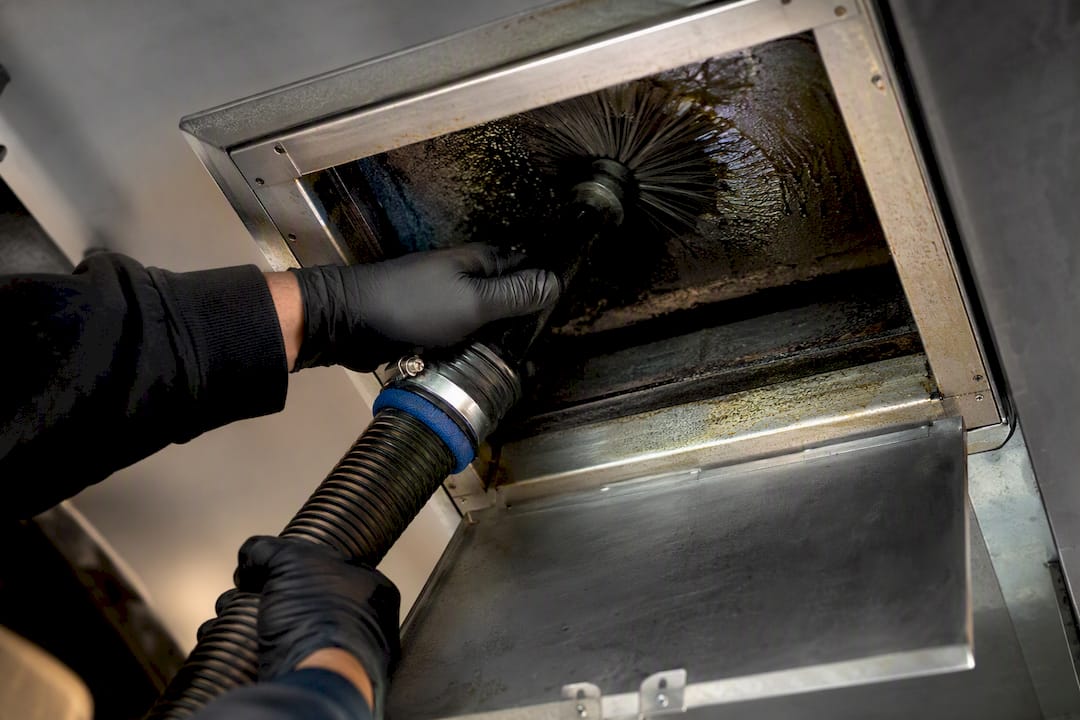
Reaching the rooftop fan and the full duct interior takes more than a mop and a degreaser spray bottle. Commercial-grade equipment and crews trained on full-system scope are needed to get grease out of sections a surface clean never touches, which is exactly where inspectors report finding the heaviest accumulation.
[Author placeholder: Brandon biography, case studies, and testimonials to be inserted per brand guidelines.]
What Most Operators Get Wrong About Compliance
Most restaurant operators treat hood cleaning as a maintenance task instead of a documentation problem. That’s backward. A kitchen can get its ducts scrubbed spotless and still fail an inspection because nobody wrote down what happened, when, or who did it. The cleaning is table stakes. The paper trail is what actually satisfies an inspector standing in your kitchen with a checklist.
The conventional advice, “clean regularly and you’ll be fine,” skips the part that actually determines outcomes: whether you can prove it. I’d argue the sticker on your hood is close to worthless on its own. It’s a reminder, not evidence. What holds up under an AHJ’s questions is the ASR with specific notes on every section, including the ones that weren’t touched and why.
If you do nothing else after reading this, fix your documentation first. A kitchen with a slightly overdue cleaning and airtight records will talk its way through an inspection faster than one with a fresh cleaning and no paperwork to show for it.
— Brandon
Get a Documented, Full-System Hood Cleaning Booked
Choosing a professional service is the alternative to guessing whether your last hood cleaning actually covered the duct and rooftop fan, or just the parts you could see from the kitchen floor. A full-system cleaning generally covers everything from canopy to rooftop, using commercial-grade equipment that reaches sections a surface clean skips entirely.
A compliant engagement with us starts with an inspection of your current system, notes on any access panel that needs attention, and a full-system cleaning covering hood, filters, plenum, ducts, and fan housing. You walk away with an ASR, a complete before-and-after photo set, and a service sticker your inspector can see the moment they walk in. Fewer citations, a stronger paper trail for your insurer, and less kitchen downtime while the work gets done.
If you’re in Colorado Springs or the Denver metro area, request a same-week quote for documented hood degreasing service in Denver and get your next inspection off your worry list.
Where to Verify These Standards Yourself
Keep these on file alongside your own cleaning records:
- NFPA 96 for the national standard text and updates on cleaning and fire protection requirements
- IKECA for certification programs and standardized cleaning process guidance
- The AHJ Hood & Duct Inspection Checklist as a downloadable reference for your own file
- Your state’s AHJ page, such as Massachusetts’s inspection program guidance, for local rule specifics
- Restaurant photo documentation guidance for standardizing your own before-and-after photo sets
Sources
- NFPA (National Fire Protection Association)
- Fightkitchenfires
- Mass
- IKECA (International Kitchen Exhaust Cleaning Association)