
Facility Teams: Match Rooftop Grease Containment to Output
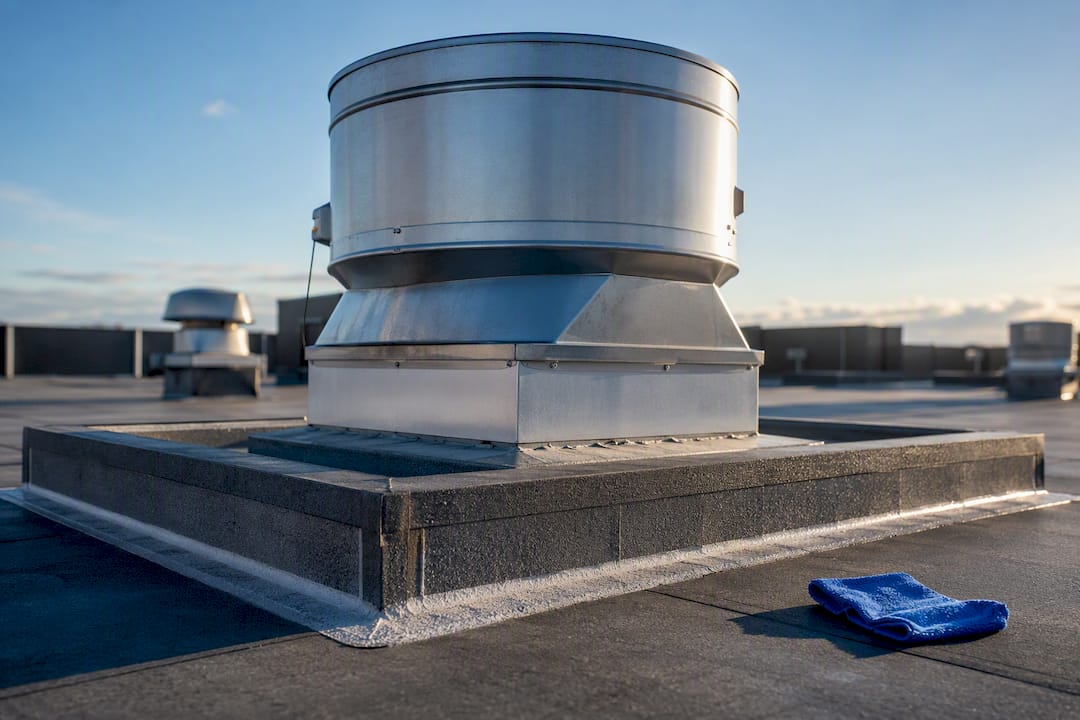
For moderate-output kitchens, start with a grease gutter or pillow/boom system. For heavy, continuous frying, evaluate a Roof Guardian or grease box instead. If your maintenance staff is stretched thin, look at an EFI interceptor first. All of it matters because NFPA 96 and EPA stormwater rules put real liability on unmanaged rooftop grease, and a licensed crew like Alldaypowerwashing can inspect and clean up what’s already accumulated.
TL;DR:
- The choice of rooftop grease containment system depends on cooking volume, weather conditions, and available rooftop space, not just cost.
- Regular maintenance, including filters or pillow swaps and visual inspections, is essential and should follow documented schedules to prevent overflow and membrane damage.
- Proper installation quality, tight seals, and clear maintenance access are critical to ensure containment effectiveness and safety.
- Compliance with NFPA 96 standards and EPA stormwater regulations requires careful storage, spill response, and inspection documentation.
- Hiring licensed professional cleaning crews for inspection and degreasing extends system lifespan and reduces the risk of roof damage and fire hazards.
Table of Contents
- What Are the Main Types of Rooftop Grease Containment?
- How Do You Choose the Right System for Your Site?
- Installing and Maintaining a Rooftop Grease Containment System
- What Codes and Environmental Rules Apply to Rooftop Grease?
- Why Professional Cleaning Extends Containment System Life
- What Actually Matters When You’re Making This Decision
- Get Your Rooftop Grease Containment Inspected
- Sources
What Are the Main Types of Rooftop Grease Containment?
Every commercial kitchen exhaust fan pushes hot, grease-laden air onto the roof, and that grease has to land somewhere. The factory-installed catch pan on most upblast fans wasn’t built to handle a full-service kitchen’s output, which is why Omni Containment Systems treats upgrading to dedicated containment as standard practice rather than an optional add-on for high-volume operations.
Grease gutter and pillow/boom systems sit around the fan perimeter and use absorbent pillows or booms to trap grease while letting rainwater drain past. They’re low-profile, relatively cheap to install, and easy to service, which makes them a solid fit for kitchens with moderate cooking volume and tight rooftop space.
Grease box systems enclose the filter media inside a weatherproof housing. That enclosure keeps rain from saturating the absorbent material, which matters because a soaked pillow stops absorbing and starts overflowing. Facilities in wetter climates or with heavy seasonal rain tend to lean this direction.
Roof Guardian (Omni) is built for kitchens that never really stop cooking. It uses multi-stage filtration and extended grease-stop walls, so overflow has somewhere to go before it reaches the roofing membrane. If your kitchen runs multiple fryers and a charbroiler for ten-plus hours a day, this is the class worth quoting first.
EFI (Exhaust Fan Interceptor) skips replaceable filter media entirely. It separates grease mechanically while still processing rainwater, which cuts the ongoing maintenance burden. That makes it a reasonable choice for sites where nobody has time to swap filters on a strict schedule.
Vendors claim specialized grease pillows can absorb up to four times their own weight in grease, though that figure assumes the media hasn’t already been compromised by standing rainwater. Ask any vendor how their absorbency number changes in wet conditions before you trust it.
| System | Best for | Capture approach | Weather handling | Maintenance frequency | Typical price range |
|---|---|---|---|---|---|
| Grease gutter / pillow-boom | Moderate-volume kitchens, tight rooftop space | Absorbent pillow or boom | Passes rainwater, media can saturate | Monthly to bi-monthly swap | Low to mid |
| Grease box (enclosed) | Facilities in wet climates needing shielded media | Enclosed absorbent filter | Enclosure blocks rain saturation | Monthly, easier in bad weather | Mid |
| Roof Guardian (Omni) | High-volume, continuous frying operations | Multi-stage filtration with overflow walls | Built for sustained heavy output | Scheduled per vendor plan | Mid to high (price varies, consult vendors for specific quotes) |
| EFI / Exhaust Fan Interceptor | Sites with limited maintenance staff | Filter-free mechanical separation | Designed to process rainwater directly | Low, minimal media replacement | Mid |
How Do You Choose the Right System for Your Site?
Start with cooking volume, not price. A single fryer running lunch shifts only needs a fraction of what a 24-hour diner with two flat-tops and a charbroiler produces. Match the containment class to actual output, not to whatever the last vendor happened to be selling.
- Audit your equipment and hours. Count fryers, charbroilers, and grills, and note how many hours per day the exhaust fans actually run.
- Measure your rooftop constraints. Curb size, fan base height, roof slope, and drainage paths all limit which systems will physically fit and drain correctly.
- Map your maintenance reality. Someone has to check filters and swap media on schedule. If nobody has that bandwidth, weight your decision toward EFI or another low-media option.
- Ask vendors for proof, not promises. Request UL or equivalent material approvals, a written NFPA 96 reference, a specific maintenance schedule, and warranty terms in writing.
- Budget both ends. Installation is a one-time cost; media replacement is recurring. A cheaper unit with expensive, frequent filter swaps can cost more over three years than a pricier system with a longer service interval.
Watch for vague answers here. A vendor who can’t name a replacement interval or point to a real capacity test is a red flag, not a minor gap.
Pro Tip: Ask for the maintenance schedule in writing before you sign anything. A vague “check it periodically” answer usually means the vendor hasn’t tested the system under your actual cooking volume.
Installing and Maintaining a Rooftop Grease Containment System
Installation quality determines whether a containment system works at all. Fan-base interfaces need a tight seal, curb deflectors have to direct grease away from the roof membrane, and mounting has to survive wind and weather without shifting. Leave clear access paths for service technicians. A system nobody can physically reach for maintenance will get skipped.
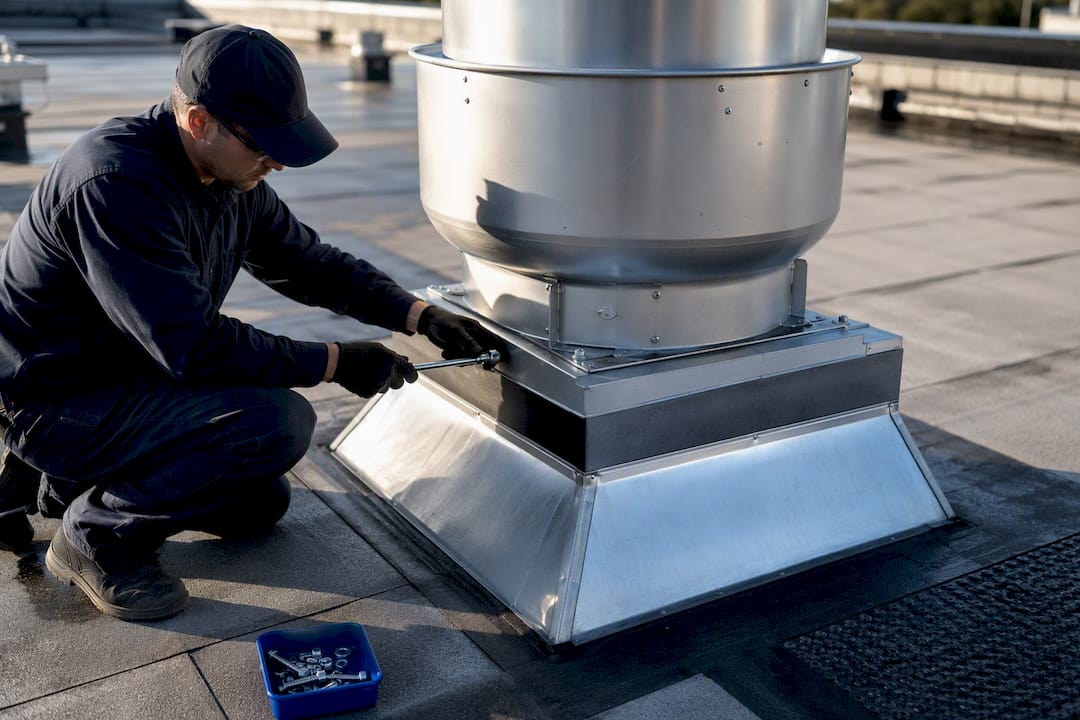
Routine maintenance depends heavily on volume. High-output kitchens generally need monthly filter or pillow swaps; lighter operations can often stretch that interval. Daily visual checks catch overflow early, before grease reaches the roof deck. Cold-weather sites should also plan for winterizing, since freezing temperatures change how grease behaves on the roof surface. Routine inspection schedules matter as much for grease containment as they do for fire suppression equipment.
Spill response has one hard rule: never use detergents. Soap emulsifies grease, and an emulsified spill travels straight into stormwater instead of staying contained. Use absorbent pads, block nearby storm drains before you start, and collect the material dry.
- Do a daily visual check for overflow or saturated media.
- Swap filters or pillows on the interval the vendor specified in writing.
- Block storm drains immediately if a spill reaches the roof surface.
- Schedule a professional inspection when you see staining on the roof deck or fan base.
A professional visit typically includes a full containment inspection, hood and duct degreasing, and a written report on what needs replacing before the next service cycle. Regular hood cleaning reduces how much grease even reaches the rooftop system in the first place.
What Codes and Environmental Rules Apply to Rooftop Grease?
NFPA 96 governs ventilation and fire protection for commercial cooking exhaust systems, and it’s the standard most inspectors reference when they check rooftop equipment. On the environmental side, EPA stormwater concerns come into play the moment grease has any path to a drain. Historical data from Goldsboro, North Carolina found that over 30% of sanitary sewer overflows in one reporting year traced back to fats, oils, and grease.
Outdoor grease storage should follow a short list of rules:
- Keep grease in leak-proof, covered containers.
- Store containers away from storm drains and catch basins.
- Keep a spill kit with absorbents on hand at all times.
- Log every inspection and cleanup for your compliance records.
Best management practices for outside storage exist precisely because a single unmanaged spill can create liability that outlasts the mess itself.
Why Professional Cleaning Extends Containment System Life
A containment system only performs as well as the surface around it stays clean. Grease that migrates past the fan base and onto the roof deck accelerates membrane breakdown and creates the slip and fire risks NFPA 96 is designed to prevent. Alldaypowerwashing brings commercial-grade equipment and insured crews to rooftop and hood degreasing jobs, backed by a satisfaction guarantee and same-week quotes for facilities that can’t afford to wait on a maintenance backlog.
Removing grease from concrete around loading docks and pad areas follows the same core rule as rooftop cleanup: absorbents and mechanical removal work, detergents that emulsify grease do not. That consistency across surfaces is part of what separates a real cleaning crew from a one-time patch job.
What Actually Matters When You’re Making This Decision
Most guidance on this topic buries the real decision under a wall of feature comparisons. Strip that away and it comes down to two variables: how much grease your exhaust actually produces, and how much maintenance attention you can realistically commit. Everything else, filter type, enclosure design, brand name, is secondary to getting those two right.
The conventional advice oversells absorbency claims and undersells maintenance discipline. A system rated to absorb four times its weight in grease is worthless if nobody swaps the media before it saturates in a rainstorm. I’d rather see a facility manager choose a mid-tier system with a maintenance plan they’ll actually follow than a premium one that gets ignored after installation.
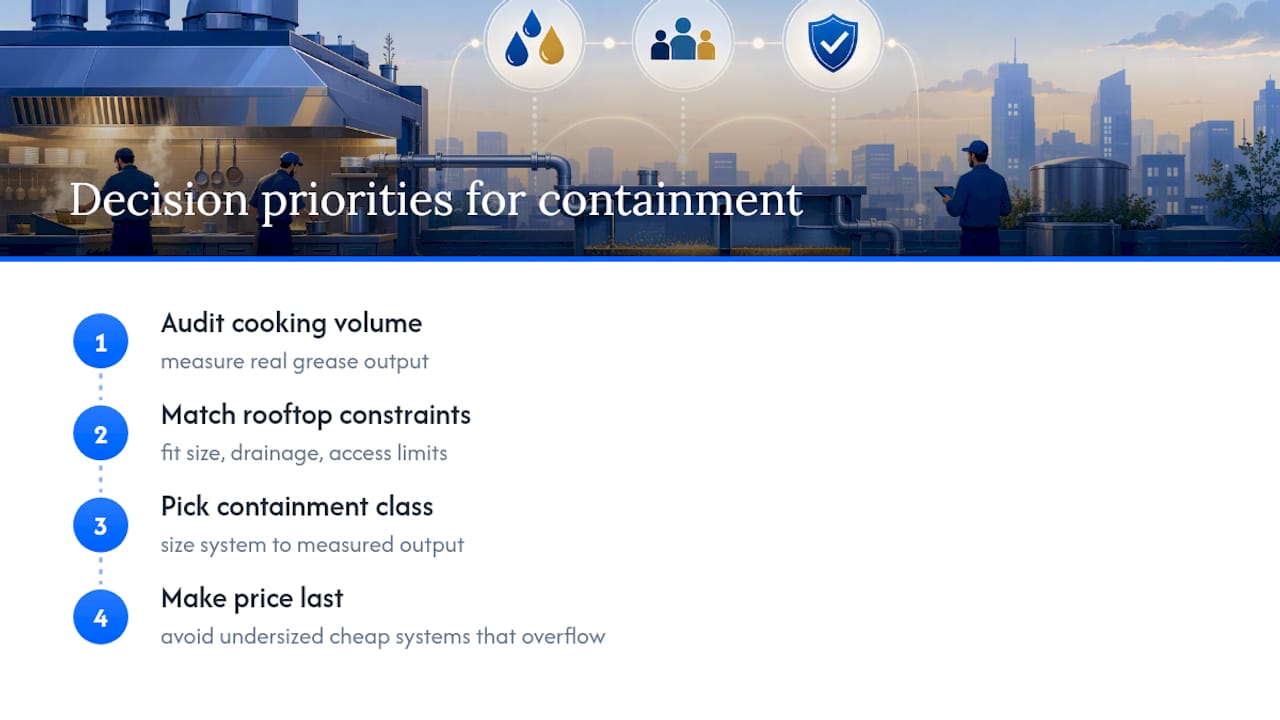
Prioritize this order: audit your real cooking volume first, match rooftop constraints second, then pick the containment class. Price should be the last factor, not the first. A cheap system that overflows twice a year costs more in roof damage than the premium option ever would have.
— Brandon
Get Your Rooftop Grease Containment Inspected
Alldaypowerwashing gives you a direct alternative to guessing at your containment gaps: a licensed local crew that actually shows up to inspect the rooftop, the hood system, and everywhere grease tends to hide, instead of a generic maintenance contract that never gets scheduled.

Every visit includes a full inspection, a prioritized list of what needs fixing now versus later, and a straightforward quote covering containment upgrades or media replacement. Crews are insured, use commercial-grade equipment, and back the work with a satisfaction guarantee. You get a same-week quote instead of waiting weeks for a callback.
If your kitchen is due for a rooftop check or you’ve already spotted grease staining near the fan base, book a quote through the Denver service page and get it handled before it turns into a bigger repair.
Sources
- NFPA 96: Standard for Ventilation Control and Fire Protection of Commercial Cooking Operations
- Best Management Practices for outside grease storage