
Hot Tire Pickup on Epoxy: What Homeowners Need to Know
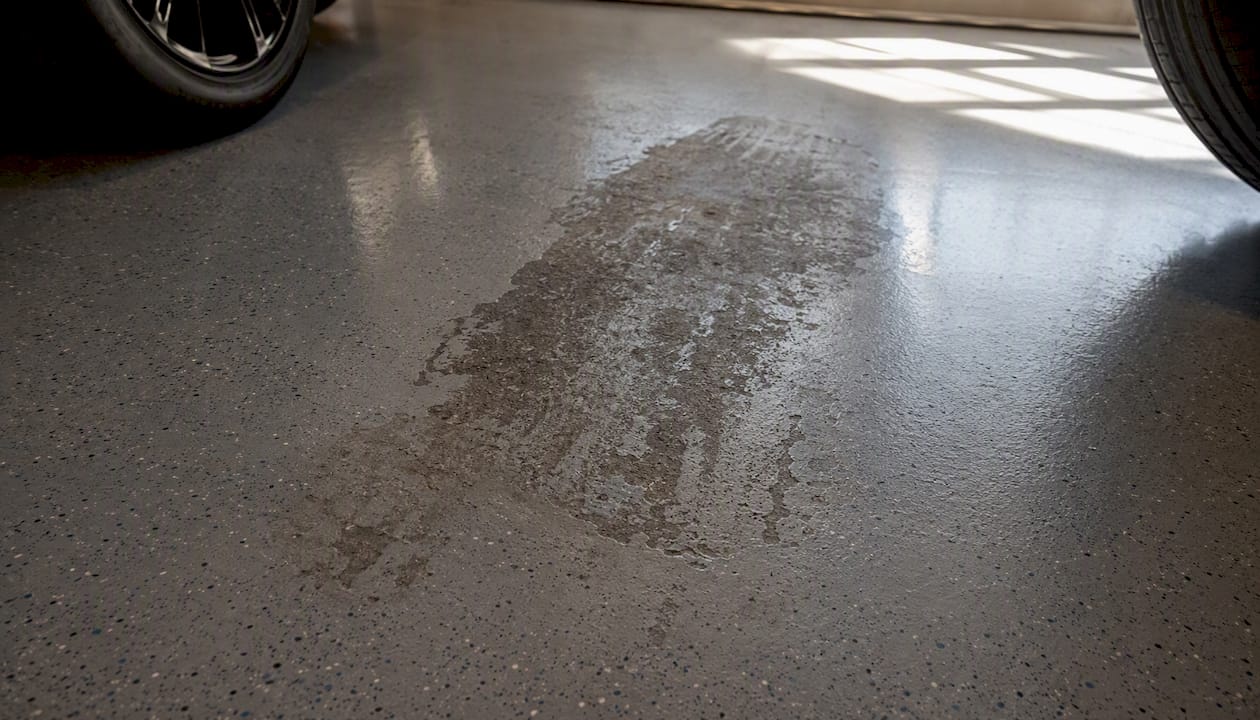
Hot tire pickup is what happens when a warm tire bonds to your garage floor coating and peels it away on the drive out. The fix is not a patch kit from a big-box store. The permanent solution is mechanical diamond grinding, a 100% solids two-part epoxy base, and a polyaspartic topcoat applied over a properly profiled, contamination-free slab.
Three things to do right now if you suspect a problem:
- Stop parking on the affected area until you assess the damage.
- Run a simple softness check: press a coin edge or your thumbnail into the coating in the tire footprint. If it dents, the film has softened and is at risk.
- Look for blisters, bubbles, or curled edges in the tire contact zone. A small isolated patch may be repairable; bubbling across the whole bay usually signals a systemic bond failure that needs a full grind-and-recoat.
Key Takeaways
Mechanical surface preparation and a 100% solids two-part coating system are the two factors that determine whether a garage floor resists hot tire pickup long-term.
| Point | Details |
|---|---|
| Stop parking immediately | Continued tire contact on a softened coating accelerates delamination and widens the damage zone. |
| Grinding is non-negotiable | Acid etch alone cannot achieve the CSP-2/3 profile required for a permanent, hot-tire-resistant bond. |
| Wait the full cure window | Most two-part epoxy systems need a minimum of 7 days before vehicle traffic; polyaspartic topcoats cure faster but still require TDS verification. |
| Match the system to the load | Water-based DIY kits fail under hot tires; a 100% solids epoxy base with a polyaspartic topcoat is the durable standard. |
| Alldaypowerwashing | Provides mechanical grinding, moisture testing, and 100% solids epoxy plus polyaspartic installs in Colorado Springs and Denver. |
Table of Contents
- 1. How hot tire pickup actually damages your epoxy floor
- 2. Surface preparation steps that actually prevent hot tire pickup
- 3. What to do when hot tire pickup has already happened
- 4. How long you need to wait before parking on a new floor
- 5. Which coating system actually resists hot tires?
- 6. DIY vs. hiring a pro: how to decide and what to ask
- What I’ve seen on Colorado garage floors
- Alldaypowerwashing handles the prep and the coating
- Sources
1. How hot tire pickup actually damages your epoxy floor
Three physical and chemical mechanisms work together to destroy a weak coating, and understanding them tells you exactly which installation shortcuts to avoid.
The sequence goes like this:
- Thermal softening. A tire that has been driven even a few miles reaches temperatures well above 100°F. When that heat transfers to the coating, it pushes the film past its glass transition temperature (Tg), the point at which a rigid polymer turns rubbery and loses its structural resistance.
- Plasticizer migration. Tire rubber contains plasticizers and oils. Once the coating softens, those compounds migrate into the film, weakening it further and breaking the bond at the concrete interface.
- Vacuum suction. As the tire cools and contracts, it creates a partial vacuum at the contact patch. If the coating is not mechanically anchored to the slab, that suction is enough to peel it clean off.
The most common failure points that make a floor vulnerable to all three mechanisms:
- Inadequate surface profile. A smooth slab gives the coating nothing to grip. Without a CSP-2 or CSP-3 profile, the bond is purely chemical and suction wins every time.
- Contamination. Oil, silicone, curing compounds, or even a dusty sweep can prevent adhesion. The coating looks fine until the first hot tire.
- Low-solids or single-pack products. DIY water-based epoxy kits from big-box stores have lower solids content and lower glass transition temperatures, which makes them far more vulnerable than 100% solids two-part systems.
- Trapped moisture. Moisture vapor pushing up through the slab breaks the bond from below, especially in warm climates. In hot and humid conditions, slab moisture combined with tire heat dramatically increases failure risk.
2. Surface preparation steps that actually prevent hot tire pickup
The biggest controllable failure point is inadequate mechanical profiling. Diamond grinding creates the concrete surface profile that prevents tire suction from pulling the coating loose. No product upgrade compensates for a smooth slab.
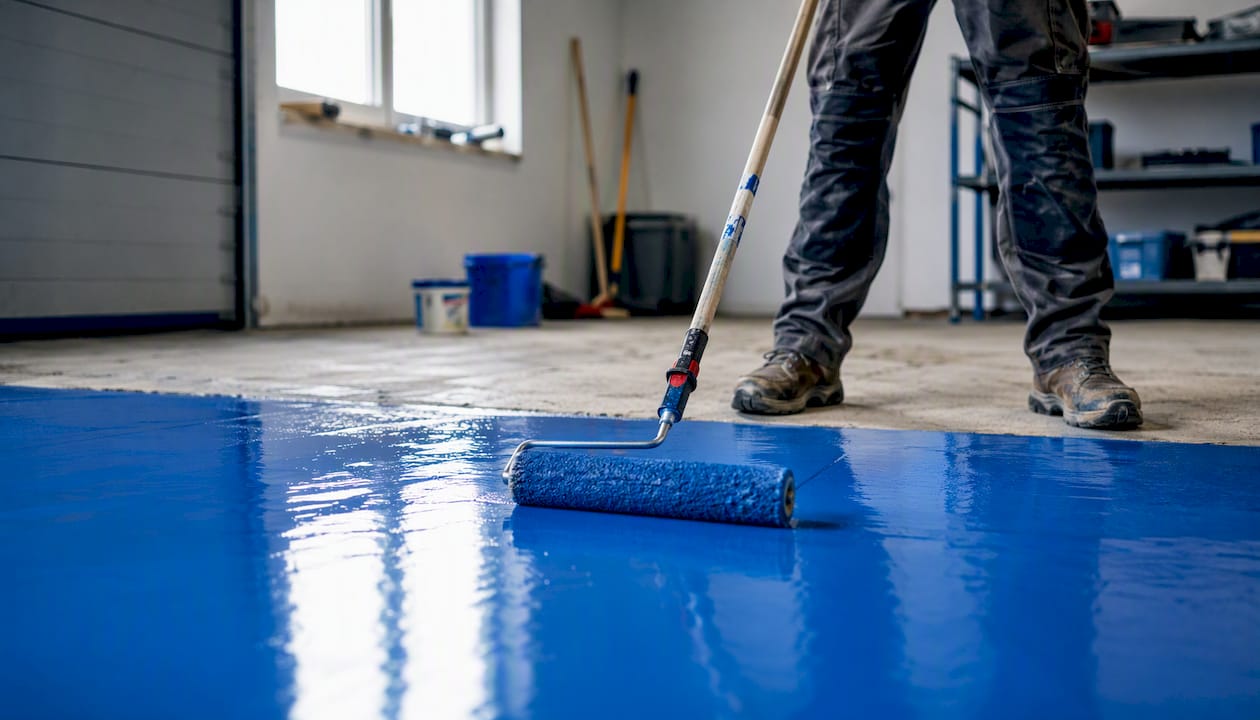
- Grind mechanically to CSP-2 or CSP-3. Use a diamond cup grinder or shot-blast machine. This opens the concrete pores, removes laitance, and creates a mechanical key the coating bonds into.
- Skip acid etching as your only prep method. Trade technical guidance is clear: acid etching usually cannot achieve the surface profile required for permanent adhesion. It may clean the surface, but it does not create the texture a hot-tire-resistant coating needs.
- Run a contamination check. Sprinkle water on the slab. If it beads up rather than soaking in, oil or silicone contamination is present. Follow with a solvent wipe (acetone or xylene on a white rag) and check for discoloration.
- Test for slab moisture. Tape a 2-foot square of plastic sheeting to the slab for 24 hours. Condensation underneath means moisture vapor is present. If it is, a moisture-vapor barrier primer is not optional.
- Apply a penetrating primer. On any slab showing moisture or porosity variation, a primer coat locks down the surface and gives the base coat a consistent substrate to bond to.
- Choose a 100% solids or solventless two-part epoxy for the base coat. Professional-grade 100% solids resins create a dense film and a structural anchor that resists plasticizer migration and suction forces far better than low-solids retail kits.
- Watch your application window. Apply between 50°F and 85°F with relative humidity below 85%. Applying in direct sun on a hot slab causes the coating to cure too fast, trapping solvent and creating a weak film. Check the product’s technical data sheet (TDS) for the exact window.
Pro Tip: Before any contractor starts work, ask to see the concrete surface profile reading after grinding. A CSP-2 or CSP-3 result is the baseline for a hot-tire-resistant installation. If they cannot show you that number, the prep is not done.
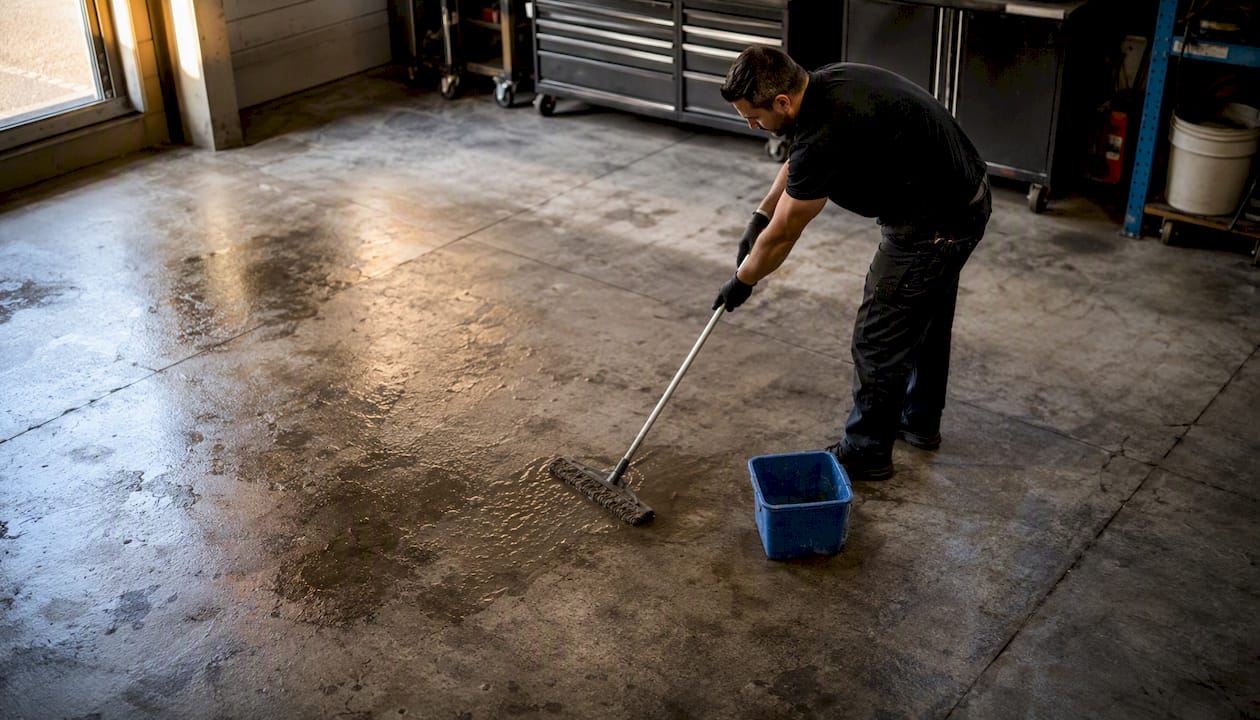
Removing oil stains and other bond-breaking contaminants before grinding is worth doing first. A thorough decontamination before mechanical prep gives the grinder a cleaner surface to work with and reduces the risk of grinding contamination deeper into the slab.
3. What to do when hot tire pickup has already happened
Assessment comes first. Not every damaged floor needs a full tear-out.
Signs of isolated, potentially repairable damage:
- Peeling limited to one or two tire contact patches
- Surrounding coating passes the coin-edge softness test (no dent)
- No blistering or bubbling outside the damaged zone
- The coating in undamaged areas is still firmly bonded (try to lift an edge with a putty knife; it should not budge)
Signs of systemic failure requiring a full grind-and-recoat:
- Blistering or soft spots across the entire floor
- Peeling that extends well beyond the tire footprint
- Evidence of moisture under the coating (white haze, widespread bubbling)
- The original prep was acid-etch only or the product was a single-pack water-based kit
Once you know which situation you are in, the repair process follows this sequence:
- Mechanically remove all delaminated coating. Grinding or scarifying back to bare concrete is the only way to create a sound substrate. Feathering a patch over a weak bond fails within a few tire cycles.
- Profile the exposed concrete. The repaired area needs the same CSP-2/3 profile as a new installation.
- Apply a penetrating primer to the ground area, especially if moisture was a factor.
- Recoat with a high-solids two-part product. Simple touch-ups are rarely permanent; mechanical grinding and re-application with high-solids resins is what actually holds. For systemic failures, a full grind-off and reinstallation with a 100% solids epoxy base and a polyaspartic topcoat is the durable fix.
For cost context, spot repairs on a sound surrounding floor run less than a full recoat, but the epoxy garage floor cost guide for Colorado covers current ranges for both scenarios so you can budget accurately before calling anyone.
Pro Tip: If a contractor quotes you a spot repair without first grinding the damaged area back to bare concrete, that repair will not last. The new coating has nothing solid to bond to.
4. How long you need to wait before parking on a new floor
Cure time is where most homeowners make the mistake that causes the problem in the first place.
- 100% solids two-part epoxy: Most professional installers recommend a minimum of 7 days before vehicle traffic. The coating may feel hard to the touch within 24 hours, but full hardness and chemical resistance take much longer.
- Polyaspartic topcoats: These often allow vehicle traffic much earlier because they cure harder faster. Check the product TDS for the specific system used; some allow light vehicle traffic within 24 hours under ideal conditions.
- Water-based epoxy kits: These need at least as long as two-part systems, often longer, because their lower solids content means more water must evaporate before the film reaches working hardness.
Conditions that extend cure time: temperatures below 60°F, humidity above 80%, poor ventilation, and thick application. A coat applied too heavily in a cold garage in October may still be soft enough to pick up a week later.
If you must park sooner than the recommended window:
- Lay cardboard or dedicated tire runners under each tire contact point. Cardboard is not glamorous, but it works.
- Park with cooled tires. Drive the car a short distance, let it sit outside for 30 minutes, then pull in. A tire that has only been idling is far less dangerous than one that just came off the highway.
- Never use rubber-backed mats or non-breathable coverings on a freshly coated floor. They trap moisture vapor and create exactly the conditions that cause blistering.
Pro Tip: Press your thumbnail into the coating in the spot where a tire will sit. If it leaves a mark, the floor is not ready. This takes five seconds and can save you a full recoat.
5. Which coating system actually resists hot tires?
Not all epoxy products are equal, and the label “epoxy” covers a wide range of performance.
| Coating Type | Hot-Tire Resistance | Cure to Vehicle Traffic | DIY-Friendly? | Best Use |
|---|---|---|---|---|
| 100% solids two-part epoxy | High | 5–7 days minimum | Difficult | Base coat on mechanically prepped slab |
| Polyaspartic topcoat | Very high | 24 hrs (system-dependent) | Difficult | Topcoat over 2K epoxy base |
| Polyurethane topcoat | High | 24 hrs | Moderate | Topcoat where UV stability matters |
| Water-based epoxy (DIY kit) | Low | 3–5 days | Easy | Light-duty floors, not vehicle traffic |
What the tradeoffs actually mean for your garage:
- Polyaspartic topcoats have higher glass transition temperatures than most epoxies, which is why a 100% solids epoxy base with a polyaspartic topcoat is the most common durable system professionals install. The epoxy base provides the structural anchor; the polyaspartic topcoat handles the heat and UV.
- Two-pack (2K) high-solids epoxy alone is a solid choice for the base layer, but without a hard topcoat it remains more vulnerable to tire heat than a two-coat system.
- Polyurethane topcoats offer good heat and chemical resistance and are worth considering when UV yellowing is a concern, though they are generally not as fast-curing as polyaspartic.
- Water-based epoxy kits are the product most likely to fail under hot tires. Their lower solids content and lower Tg make them the wrong tool for a garage that sees regular vehicle traffic, especially in warm climates.
For a side-by-side look at specific product classes available locally, the best epoxy garage floor coatings guide covers the options Alldaypowerwashing installs in Colorado.
6. DIY vs. hiring a pro: how to decide and what to ask
Some garages are reasonable DIY candidates. Most are not, and the factors that push a job toward professional territory are exactly the ones that cause hot tire pickup.
Factors that favor hiring a professional:
- You have a vehicle heavier than a standard passenger car (truck, SUV, or any commercial vehicle)
- The slab shows moisture (the plastic sheet test came back positive)
- The garage is in a climate with hot summers (Colorado’s Front Range included)
- A previous coating has already failed
- You do not own or cannot rent a diamond cup grinder
Factors that make a DIY approach more reasonable:
- Light passenger car only, parked infrequently
- Dry slab with no moisture history
- You are willing to use a 100% solids two-part kit (not a water-based single-pack)
- You can rent a proper grinder and follow the TDS exactly
Questions to ask any contractor before signing:
- What CSP level will you achieve, and how will you verify it?
- What moisture testing method do you use, and what result triggers a vapor barrier primer?
- Can I see the product data sheet for the base coat and topcoat?
- What is the minimum cure time before I can park on it?
- What does your warranty cover, and is it in writing?
Red flags that should end the conversation:
- “You can park on it in 24 hours” (for a full epoxy system, not a polyaspartic-only topcoat)
- “We prep with acid etch” as the complete answer to surface preparation
- Vague product names with no TDS available
- No written cure specs or warranty
- No mention of moisture testing
If you are preparing the garage for a sale or inspection, pairing a fresh floor coating with a quick garage door inspection covers the two most visible elements buyers notice first.
What I’ve seen on Colorado garage floors
Colorado’s climate creates a specific version of this problem that homeowners here underestimate. The Front Range gets hot summers with intense UV, and garages that face west or south can see slab temperatures well above ambient air temperature by mid-afternoon. That means a tire that has only been driven a few blocks arrives on a slab that is already warm, compressing the thermal softening window considerably.
The floors we see fail most often in Colorado Springs and Denver share two traits: they were prepped with acid etch only, and the product was a single-pack water-based kit purchased at a home improvement store. The coating looks fine for the first season. By the second summer, the tire contact patches start lifting. By the third, the homeowner is calling for a full grind-and-recoat.
The floors that hold up are the ones where someone ran a diamond grinder until the concrete had real texture, tested for moisture, and used a 100% solids two-part base with a polyaspartic topcoat. That system costs more upfront. It does not cost a second installation.
If you are in Colorado Springs or Denver and want a site evaluation before committing to a repair or new installation, that is exactly what Alldaypowerwashing does. The evaluation covers slab condition, moisture, and the right product class for your specific garage and vehicle load.
Alldaypowerwashing handles the prep and the coating
Skipping the grind is the single most common reason garage floors fail under hot tires. Alldaypowerwashing’s epoxy floor coating service in Colorado Springs and Denver starts with mechanical diamond grinding to CSP-2/3, moisture testing, and a primer where the slab needs it, before any coating goes down. The base coat is a 100% solids two-part epoxy; the topcoat options include polyaspartic finishes in solid, metallic, and flake styles.

If your floor is already showing tire pickup damage, the team can assess whether a targeted repair is viable or whether a full grind-and-recoat is the honest answer. Same-week quotes are available for both. Request a quote with your garage size, vehicle types, and a description of what you are seeing, and Alldaypowerwashing will give you a straight answer on what the job actually requires.
Sources
- Hot tyre pick-up explained — Real World Epoxies
- How to epoxy your garage floor: The step-by-step guide that actually works (2026) - Pro Garage Gear
- Hot Tire Pickup on Epoxy Garage Floors in Jacksonville & Florida - Apex Epoxy Flooring
- How to Prevent Hot Tire Pickup on Epoxy: The Professional’s Guide to Permanent Adhesion - Illuminated Coatings
- Hot Tyre Pickup on Epoxy Floors: Causes and Prevention - Polycote
- Effective hot tire pickup garage floor solution for Florida homes — Florida Granite Garage Floors
Always request the product technical data sheet (TDS) before purchasing any coating or signing a contract. The TDS states the actual Tg, solids content, cure times, and application conditions, and those numbers tell you more than any marketing claim.