

Avoid Fines: Colorado Pressure Washing Wastewater Rules and Checklist
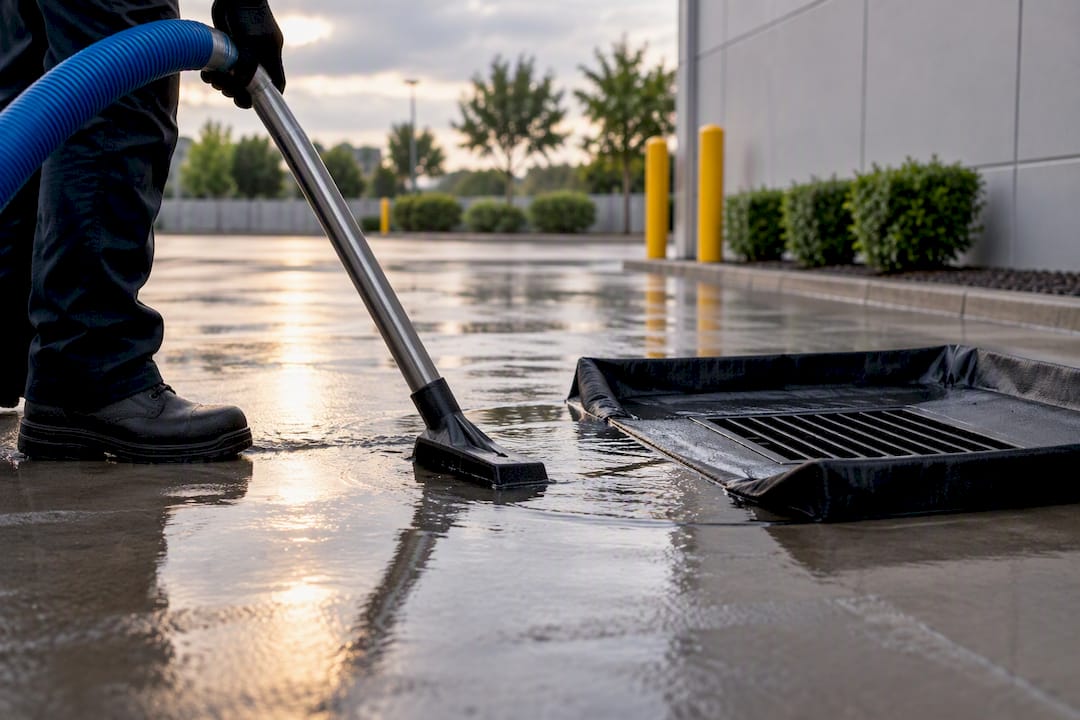
You cannot let pressure-washing wastewater run into a storm drain, gutter, or ditch in Colorado without a permit, and doing so can trigger fines from both the city and the state. Discharge to permeable land is sometimes allowed if you meet the state’s low-risk conditions; otherwise you need to capture the water. Before you turn on a hose: block the nearest drain, keep runoff on-site, snap a few photos of the setup, and call your local wastewater authority if there’s any chance you’ll need sanitary sewer access.
TL;DR:
- Discharging pressure-washing wastewater into storm drains without permits can lead to fines from local and state authorities and may require capturing all water unless conditions qualify for low-risk land discharge.
- Meeting every step of site preparation, including blocking drains and using containment during operation, is essential to avoid accidental illegal discharges and associated penalties.
- Jobs involving chemicals, oils, or heavy soil generally require sewer connection, licensed hauling, or containment; only plain-water jobs on permeable land with no sheen or erosion may qualify for low-risk land discharge.
- Property owners and contractors must have clear disposal agreements, proper documentation, and follow local permitting processes, which can range from same-day approvals to several weeks depending on job complexity.
- Larger or commercial jobs touching fuel, grease, or lead paint still require active containment and disposal methods, as low-risk land discharge never applies to contaminated or large-volume projects.
Table of Contents
- Wastewater Rules for Pressure Washing in Colorado: The On-Site Checklist
- Why Storm Drains Count as Protected Waterways
- What Counts as “Low-Risk” Discharge Under State Guidance
- Sanitary Sewer, Licensed Hauler, or Contained Evaporation: Picking a Disposal Method
- Surfaces and Sites That Demand Stricter Controls
- Who’s on the Hook: Property Owners, Managers, and Contractors
- Getting Local Approval: Who to Call and What to Ask
- Sampling and Testing: When the State Wants Proof, Not Just a Checklist
- How Long Permitting Actually Takes in Colorado
- Handling Hazardous Material in Wash Water
- State Rules vs. City Ordinances: What Changes Where You Work
- Beyond Fines: What Real Enforcement Looks Like
- A Working Crew’s View: Sequence Beats Shortcuts
- When You Need a Crew That Already Knows the Rules
- Where to Verify the Rules Yourself
- Sources
- FAQ
Wastewater Rules for Pressure Washing in Colorado: The On-Site Checklist
Most compliance failures happen before the first gallon of water even hits the pavement. Crews skip the prep, assume “it’s just water,” and end up with soapy runoff heading straight for a storm grate. Here’s the sequence that keeps a job clean, legally and literally.
Before the job starts:
- Sweep and dry-clean the surface first. Removing loose grease, dirt, and debris by hand cuts the pollutant load dramatically before any water touches the ground, which is often the single cheapest compliance step on the whole job.
- Walk the site and mark every storm drain, catch basin, and low point where water naturally flows.
- Confirm your disposal path in advance. Know whether you’re aiming for permeable land, a sanitary sewer connection, or a vacuum truck before you start.
During the wash:
- Plug or cover storm drains with rubber mats, drain guards, or sandbag berms.
- Set up containment berms around the perimeter of hard surfaces to keep water from migrating toward the street.
- Use oil-absorbent pads or socks anywhere vehicles park or fuel, since petroleum residue is the fastest way to turn a routine job into an enforcement issue.
- Run a wet vac or vactor truck continuously on larger commercial jobs rather than letting water pool and spread.
After the wash:
- Transport collected water to an approved sanitary sewer connection or have a licensed hauler remove it.
- Photograph the finished site, including blocked drains and any containment gear still in place.
- Get a sign-off from the property owner or manager confirming the disposal method used.
Pro Tip: Capture the first rinse water even on surfaces that look clean. That initial pass typically carries the highest concentration of oils, dirt, and residue, and it’s the water most likely to cause a sheen if it reaches a drain.
Why Storm Drains Count as Protected Waterways
Storm drains connect directly to rivers, streams, and reservoirs in most Colorado cities, and federal law treats them as an extension of those waterways rather than as a wastewater disposal system. That single fact drives nearly every rule discussed in this article.
The Clean Water Act’s NPDES stormwater program prohibits discharging pollutants into waters of the United States without a permit, and municipal separate storm sewer systems, known as MS4s, fall squarely under that program. A city storm drain is not a treatment facility. Whatever goes in it, whether that’s detergent, grease, or dirty rinse water, typically flows untreated into a creek or lake.
Colorado implements this federal mandate through its own regulatory structure. The Code of Colorado Regulations, specifically Regulation No. 84, governs reclaimed and industrial wastewater categories, spelling out which discharges need a permit, which qualify for exemptions, and how the state’s delegated authority under the Clean Water Act actually functions on the ground. The Colorado Department of Public Health and Environment (CDPHE) administers this framework statewide, which means the state sets the baseline rules that every city then enforces locally.
That local enforcement layer is where most pressure washing operators actually encounter the law. Cities and counties adopt illicit discharge ordinances tied to their MS4 permits, and code enforcement or environmental services staff, not federal EPA agents, are the ones who show up on-site. The practical hierarchy works like this:
- Federal law (the Clean Water Act) sets the baseline prohibition on unpermitted discharges to waters of the United States.
- State regulation (CDPHE and the Code of Colorado Regulations) translates that prohibition into Colorado-specific categories, exemptions, and guidance.
- Municipal ordinances enforce the rule day-to-day, often through a city’s stormwater or environmental services department.
This layered structure explains why a Denver crew and a Colorado Springs crew might hear slightly different language from their local inspector even though both are ultimately answering to the same federal statute. Denver’s own guidance states plainly that wastewater containing detergents, oils, or other pollutants cannot be allowed to enter storm drains, and that containment and proper disposal may be required before a job even starts.
Penalties vary by jurisdiction, but the pattern is consistent. A first offense is often a warning paired with a stop-work order until containment is fixed. Repeat or willful violations escalate quickly into per-day civil fines, and cities routinely bill the cost of any cleanup or remediation back to the property owner or contractor responsible. Because enforcement authority ultimately traces back to a federal statute, an inspector who documents a serious or repeated violation can refer the case for citations under the Clean Water Act itself, which carries a different order of magnitude in penalties than a municipal ticket.
What Counts as “Low-Risk” Discharge Under State Guidance
Colorado does carve out a narrower path for certain pressure washing jobs, and it hinges on one word: cosmetic. State guidance treats plain-water, no-chemical surface cleaning differently than jobs involving detergents, degreasers, or heavy soil removal, because plain water carries a much lower pollution risk when it’s handled correctly.
The state guidance document distributed through Canon City lays out the specific conditions a job must meet to qualify for this low-risk pathway rather than needing a formal permit:
- No detergents, soaps, or chemical cleaning agents are used, meaning it’s plain water only.
- The water fully infiltrates into permeable land such as soil, gravel, or landscaped areas, rather than running off across pavement.
- There’s no visible sheen, no floating debris, and no oily film on the water as it discharges.
- The discharge causes no erosion and does no visible damage to vegetation or landscaping.
- The job isn’t happening during or immediately after a storm event, when the ground is already saturated and can’t absorb additional water.
- The water never reaches an irrigation ditch, storm drain, or surface water body like a creek or pond.
Meet every single one of those conditions, and a job can often legally send its wash water onto permeable ground instead of requiring capture and hauling. Miss even one, and you’re back to needing a formal disposal method.
If no detergents or chemicals are used and the water soaks into permeable land without sheen, erosion, or harm to vegetation, certain “surface cosmetic” power-washing discharges may be managed under state low-risk guidance rather than a full discharge permit.
That’s a real opening for straightforward residential jobs like plain-water house rinses on properties with generous yard space. It’s not a loophole for anything involving soap, degreaser, or a commercial surface with heavy grease buildup.
The best-management practices that support this pathway are worth building into every job regardless of whether you’re relying on the low-risk exemption:
- Remove loose solids and debris before you ever turn on water.
- Deploy filter bags at the discharge point to catch sediment before it reaches soil or a drain.
- Keep oil-absorbent pads on hand for any surface with vehicle traffic history.
- Control your flow rate deliberately. A slow, steady stream that the ground can absorb beats a firehose blast that creates runoff and erosion.
One nuance that trips up a lot of otherwise careful operators: this low-risk pathway is not a permanent legal shield. It’s a guidance framework, and state guidance itself frames it as conditional, not automatic. If your discharge ends up polluting a waterway despite checking every box on the list, you’re still exposed to enforcement. The smarter approach is to treat the checklist as a floor, not a ceiling, and to focus on the actual outcome: no sheen, no off-site flow, no complaints from a downhill neighbor.
Sanitary Sewer, Licensed Hauler, or Contained Evaporation: Picking a Disposal Method
Once a job doesn’t qualify for low-risk land discharge, you have three realistic options for getting rid of the water legally. Each comes with its own approval process, cost profile, and best-fit scenario, and Colorado wastewater guidance consistently points operators toward these same three paths.
1. Discharge to the sanitary sewer. This is usually the cleanest long-term solution for recurring commercial work, but it requires upfront legwork. You need explicit approval from the local wastewater treatment authority before connecting to a cleanout, and many municipalities want to know what surfactants or degreasers might be present so they can assess pretreatment needs. Restaurants and sites with grease programs face an extra layer here: even a sanitary discharge may need pre-approval or routing through a grease interceptor, so checking with the local wastewater treatment plant’s FOG coordinator before you plan a sewer discharge saves a lot of grief later. Expect the approval process to take anywhere from a same-day phone call for a small residential cleanout to several weeks if a municipality wants written documentation or a site visit first.
-
Hire a licensed liquid waste hauler. For one-off commercial jobs, or sites where sanitary sewer access simply isn’t practical, a vacuum truck or tank service collects the wastewater and transports it to a permitted treatment facility. This method carries the highest per-job cost of the three, since you’re paying for transport and disposal fees on top of the cleaning itself, but it also carries the lowest compliance risk because a licensed hauler documents the chain of custody with a disposal manifest.
-
Contain and let it evaporate. This works only for small residential jobs on impervious surfaces like a driveway or patio, where the total water volume is modest and there’s zero risk of runoff before evaporation finishes. It’s not viable for large commercial flatwork, parking structures, or any surface with active water intrusion, because the volume simply overwhelms what evaporation can handle before rain or wind pushes it toward a drain.
Pro Tip: Filter the water through a fine mesh or filter bag before it ever reaches a containment area, sewer connection, or hauler’s tank. Removing solids upfront reduces the risk of clogging equipment and keeps you well within any pretreatment standards a sanitary authority might apply.
Cost tends to follow risk in a predictable pattern. Plain-water residential jobs that qualify for low-risk land discharge cost nothing extra. Sanitary sewer discharge adds a modest coordination cost, mostly your time getting approval. Licensed hauling adds the most direct expense but removes almost all liability once the manifest is signed. Property managers weighing pressure washing costs for a parking lot or commercial pad should factor disposal method directly into the quote, since a job requiring a hauler will run meaningfully higher than one that can rely on land discharge.
Surfaces and Sites That Demand Stricter Controls
Some surfaces simply don’t play by the standard rules, and treating them like an ordinary driveway or house wash is how operators end up on the wrong side of an inspector’s clipboard.
- Gas station forecourts and fueling areas. Petroleum residue soaked into concrete doesn’t rinse away clean. Wash water from these surfaces almost always needs full containment and hauling, never land discharge, because even trace fuel contamination creates a visible sheen that’s an immediate red flag for any inspector.
- Restaurant grease pads and dumpster corrals. Fats, oils, and grease accumulate fast around commercial kitchens, and these sites often fall under a municipality’s FOG (fats, oils, grease) program even before pressure washing enters the picture. Coordinate with the property’s grease-interceptor maintenance schedule and confirm sewer discharge is actually approved before you start.
- Lead-painted surfaces on older buildings. EPA’s RRP rule doesn’t ban pressure washing lead-painted surfaces, but it does require containment so paint dust and debris, wastewater included, don’t leave the work area. Depending on lead concentration, that wastewater may need to be handled as hazardous waste rather than routed to a standard disposal path.
- Large commercial flatwork. Big parking lots, loading docks, and warehouse aprons generate volumes of water that evaporation simply can’t absorb fast enough. These jobs almost always need active capture, whether through a vactor truck or a sanitary sewer connection, because the surface area alone rules out contained evaporation as a realistic option.
If a job touches any of these categories, assume you need active capture and documented disposal from the start rather than hoping the low-risk pathway will cover you.
Who’s on the Hook: Property Owners, Managers, and Contractors
Colorado law doesn’t let property owners off the hook just because they hired someone else to do the washing. State guidance is explicit that owners can be held liable for illegal discharges caused by a contractor working on their property, which makes the paperwork around a pressure washing contract far more important than most property managers realize.
Here’s what to build into any service agreement before a crew shows up:
- Spell out the disposal method in writing. The contract should name exactly how wastewater will be captured and where it’s going, whether that’s land discharge under low-risk conditions, sanitary sewer, or a licensed hauler.
- Require proof of insurance and containment equipment. Ask to see that the contractor carries liability coverage and actually owns or rents the berms, filter bags, and vacuum equipment the job requires.
- Add an indemnity clause. This shifts financial responsibility for discharge violations back to the contractor if their equipment or process is what caused the problem.
- Require documentation after every job. Photos of blocked drains, a signed disposal receipt from a hauler, or written sewer-discharge approval should all land in your file, not just live in someone’s phone.
Pro Tip: Before a crew starts, walk the site with them and take your own photos of every storm drain and low point. If a dispute ever comes up later, having your own timestamped record matters more than taking the contractor’s word for it.
On-site verification is worth doing even with a trusted contractor. Confirm the recovery equipment is actually set up before water starts flowing, not after. Check that drain covers are in place. And keep every signed disposal receipt or WWTP approval letter on file for at least a full year, since that’s typically the window during which a complaint or inspection could reference a specific job.
Getting Local Approval: Who to Call and What to Ask
Every Colorado municipality routes wastewater approvals differently, but the sequence of steps looks similar almost everywhere.
- Call the local wastewater treatment authority first, before you assume sanitary sewer discharge is available. Ask specifically about cleanout access rules, any FOG restrictions that might apply to your site, and whether pretreatment or water testing is required before connection.
- Ask whether your job needs a CDPS individual permit or falls under a general municipal permit instead. Most routine commercial washing doesn’t require an individual Colorado Discharge Permit System permit, but sites with unusual contamination risk, like industrial facilities, sometimes do.
- Pull the actual municipal ordinance text, not just a summary page. City websites, including Denver’s business licensing portal, typically link to the illicit discharge ordinance that governs stormwater rules in that jurisdiction.
- Keep every piece of documentation an inspector might ask for: written approval from the wastewater authority, signed manifests from any hauler used, dated photographs of containment setups, and a running log of which disposal method was used on which job.
Timelines vary. A small residential job with a simple sanitary sewer question can often get verbal or email approval within a day or two. Commercial sites, especially ones with FOG program overlap or unusual site conditions, can take two to four weeks if the authority wants a written application or site inspection before granting approval. Building that lead time into a commercial bid avoids a scheduling scramble later.
Sampling and Testing: When the State Wants Proof, Not Just a Checklist
Most routine residential and small commercial pressure washing jobs never require formal water sampling. The state’s low-risk guidance is built specifically so that plain-water, cosmetic cleaning jobs can rely on visual and procedural checks, no sheen, full infiltration, no erosion, instead of lab testing.
Sampling becomes relevant once a job moves outside that low-risk category. If you’re discharging to a sanitary sewer at a site with any history of industrial use, grease accumulation, or chemical cleaning agents, the local wastewater treatment authority may ask for a water sample before granting approval, particularly to check for oil and grease concentration or pH levels that could interfere with the treatment plant’s process. This is standard pretreatment screening, not a punitive measure, and it’s usually a one-time check tied to establishing an ongoing discharge relationship rather than something required on every single job.
For most operators, the practical move is simpler than running lab tests: avoid the need for sampling altogether by choosing a disposal method that doesn’t trigger it. Land discharge under low-risk conditions and licensed hauling to a permitted facility both sidestep the sampling question, since the hauler’s own permit covers water quality on the receiving end. Sanitary sewer discharge is the one path where a wastewater authority might reasonably request a sample, especially for a first-time commercial account, so building that possibility into your timeline avoids a surprise delay.
How Long Permitting Actually Takes in Colorado
The permitting timeline depends almost entirely on which disposal path you’re pursuing, and conflating them is where a lot of scheduling mistakes happen.
Low-risk land discharge requires no permit at all, only adherence to the state’s conditions. There’s no application, no waiting period, no approval letter. You simply confirm the site meets every condition and proceed.
Sanitary sewer discharge is where timelines start to vary. A residential job connecting to an existing cleanout for a modest volume of plain water might get verbal approval from the local authority within a single phone call. A commercial account, especially a new one or one near a FOG-sensitive area like a restaurant corridor, typically involves a written request, and some municipalities want a site visit before signing off. Budget two to four weeks for that process if you’re setting up a recurring commercial relationship for the first time, though a one-off job can sometimes move faster if the authority is responsive.
A CDPS individual permit, which applies to a much narrower set of situations involving unusual contamination risk or industrial-scale discharge, is a genuinely different animal. That application process runs through CDPHE directly rather than a local authority, and it can take considerably longer, often several months, because it involves technical review rather than a simple approval call. Most pressure washing operators in Colorado will never need this level of permit. If your job involves something beyond routine cosmetic cleaning, industrial equipment washdown or a site with known contamination, ask CDPHE directly rather than assuming a standard municipal approval will cover it.
Handling Hazardous Material in Wash Water
Not all wash water is created equal, and some of it needs to be treated as hazardous waste rather than routine wastewater. The clearest example is lead paint. Washing an older building’s exterior can knock loose paint chips and dust into the rinse water, and EPA’s RRP requirements mandate containment specifically so that debris, water included, doesn’t leave the work area uncontrolled.
Once that water is contained, what happens next depends on lead concentration and volume. Small residential jobs typically manage this through careful capture and standard disposal, but larger commercial stripping or renovation projects should test the collected water and paint debris before assuming it can go down a sanitary sewer or onto land. A wastewater authority will generally reject a discharge request outright if you disclose lead contamination, and disposing of genuinely hazardous material through a standard channel exposes both the contractor and property owner to far more serious liability than a routine stormwater violation.
Fuel and solvent residue from gas station forecourts or auto shops falls into a similar category. That wash water isn’t just “dirty,” it carries petroleum contaminants that most sanitary sewer systems and land discharge pathways aren’t equipped to handle. These situations call for licensed hazardous waste handling rather than a standard liquid waste hauler, and the cost difference reflects that added regulatory burden.
State Rules vs. City Ordinances: What Changes Where You Work
Colorado’s baseline rules apply everywhere in the state, but the practical experience of complying with them shifts noticeably from one municipality to the next. CDPHE and the Code of Colorado Regulations set the floor: no unpermitted discharge to waters of the state, delegated authority under the Clean Water Act, and the low-risk guidance framework for cosmetic cleaning. Every city in Colorado operates within that floor.
What varies locally is enforcement mechanics. Denver’s approach routes questions through its business licensing framework and explicitly names detergents, oils, and pollutants as prohibited in storm drains. Smaller municipalities, like Canon City’s guidance document referenced throughout this article, sometimes publish more detailed low-risk discharge criteria than larger cities, simply because they’ve had specific enforcement questions come up locally. Colorado Springs, like Denver, enforces its MS4 permit through its own stormwater program, and a Colorado Springs job may involve a different point of contact than an identical job across the state.
The practical takeaway: don’t assume a rule you learned working in one Colorado city applies identically in another. Always confirm with the specific municipality’s stormwater or environmental services department before a commercial job, especially one involving sanitary sewer discharge, since that’s the layer where local variation actually shows up.
Beyond Fines: What Real Enforcement Looks Like
A civil fine is the most visible consequence of an illegal discharge, but it’s rarely the only one. Repeated or willful violations can escalate into criminal charges under the Clean Water Act itself, since the statute that underlies every state and municipal rule in this article carries criminal penalties for knowing violations, not just civil ones. That’s a rare outcome for a routine pressure washing mistake, but it becomes a real risk when a contractor or property owner ignores repeated warnings or actively falsifies documentation about a disposal method.
More commonly, enforcement affects a business’s ability to operate. A municipality can suspend or revoke a contractor’s local business license following serious or repeated violations, which shuts down operations far more effectively than a one-time fine ever could. Commercial property owners can also face complications with their own permits or insurance if a documented discharge violation shows up during an unrelated inspection or claim.
Cleanup costs add another layer entirely. If a discharge actually reaches a waterway and causes measurable environmental harm, the responsible party, owner and contractor both, can be billed for remediation costs that dwarf the original fine. These costs aren’t capped the way a municipal citation might be, and they scale directly with the size of the spill and the difficulty of the cleanup.
The pattern across nearly every enforcement case is the same: violations that stem from carelessness get a warning, violations that stem from ignoring documented containment requirements get real financial consequences.
A Working Crew’s View: Sequence Beats Shortcuts
Every containment failure I’ve seen traced back to skipped sequencing, not bad intentions. Crews that treat dry cleanup as optional, or that set up containment after the water’s already flowing, are the ones who end up explaining themselves to an inspector.
The sequence that actually holds up on Colorado job sites is dry cleanup first, containment second, filtration third, active vacuum recovery fourth, and approved disposal last. Skip a step, and you’re improvising in front of a client or a code enforcement officer, which is a bad place to be improvising.
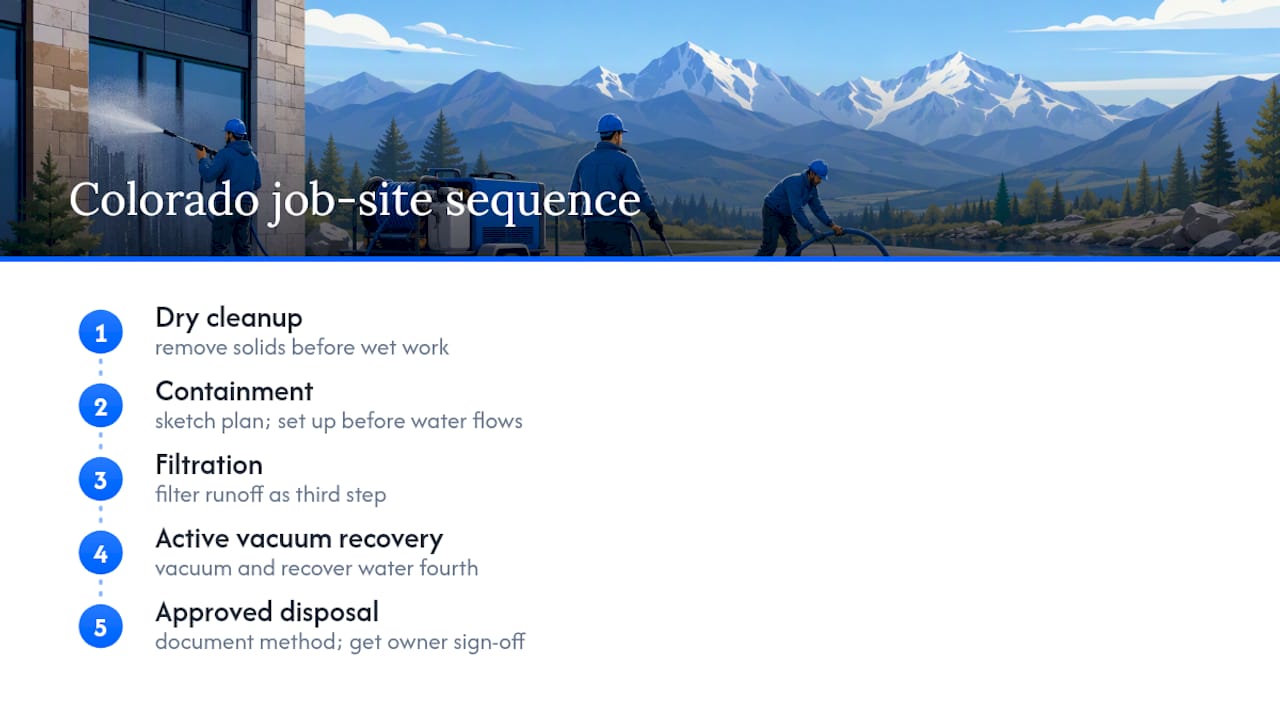
Inspectors tend to flag the same handful of issues repeatedly: unblocked drains, no visible containment plan, and no documentation proving where the water actually went. The fix for all three is embarrassingly simple. Photograph the site before, during, and after. Sketch a quick containment plan on a whiteboard or notepad before the crew starts, even for a routine job. Get the property owner or manager to sign off on the disposal method used, every single time, not just for the big commercial jobs.
None of this requires exotic equipment or a legal background. It requires treating the sequence as non-negotiable, because the state’s low-risk guidance rewards outcomes, not good intentions.
— Brandon
When You Need a Crew That Already Knows the Rules
Hiring blind for a commercial pressure washing job in Colorado means gambling on whether the crew showing up actually understands containment, or whether you’ll be the one explaining a drain violation to a city inspector later. Certain pressure washing operators run commercial-grade recovery equipment on applicable jobs and coordinate licensed hauler disposal when sanitary sewer access isn’t an option, meaning the compliance planning this article just walked through is built into how some jobs get scheduled.

Crews cover Colorado Springs and the Denver metro area, carry full insurance, and back every job with a satisfaction guarantee. Services span house washing, fleet and heavy equipment cleaning, kitchen hood degreasing under NFPA-96 standards, gutter cleaning, and concrete and trash pad cleaning, all handled by real crews on real job sites rather than subcontracted out to whoever’s available that week. Denver metro property managers can see local coverage details directly on the Denver service page, and same-week quotes mean a compliance question doesn’t turn into a weeks-long scheduling delay. Request a quote today and ask specifically about containment and disposal planning for your site before the first truck shows up.
Where to Verify the Rules Yourself
State and federal agencies publish the actual rule text behind everything covered above, and it’s worth bookmarking these directly rather than relying on secondhand summaries.
- EPA’s NPDES stormwater program page covers the federal Clean Water Act framework that underlies every state and municipal rule in Colorado.
- Regulation No. 84 in the Code of Colorado Regulations lays out the state’s reclaimed and industrial wastewater categories and exemptions.
- Canon City’s published state guidance document gives the clearest available breakdown of low-risk discharge conditions.
- Denver’s business licensing portal shows how one major Colorado municipality structures its permit and enforcement process.
- EPA’s guidance on RRP requirements for pressure washing covers containment obligations for lead-painted surfaces specifically.
This article is general information, not a substitute for advice from a qualified lawyer. Consult a qualified legal professional about your own circumstances before acting on anything here.
Sources
- State Guidance on Power Washing (Canon City) — Low Risk Discharge Guidance
- EPA NPDES stormwater program
- Code of Colorado Regulations — Regulation No. 84 (reclaimed water control regulation)
- Pressure Washing Wastewater Disposal: Rules and Methods · EosLog
- Pressure Washing Permit Requirements in Denver, CO
FAQ
What Is the Purpose of Colorado Regulation 43?
Colorado regulations concerning wastewater pretreatment and industrial discharge standards are part of the regulatory framework that governs when businesses can discharge wastewater into the sanitary sewer system. If your pressure washing job involves sanitary sewer discharge from a commercial site, ask your local wastewater treatment authority whether pretreatment standards under this broader regulatory framework apply to your specific discharge.
Are Greywater Systems Legal in Colorado?
Yes, Colorado permits greywater systems for household use like laundry and shower water, but they’re regulated separately from pressure washing wastewater and require specific permitting through local health departments. Pressure washing runoff, which often carries dirt, oil, or detergent residue, doesn’t qualify as greywater and follows the stormwater and sanitary sewer rules covered throughout this article instead.
Does Greywater Have to Go Into a Septic Tank?
Greywater systems in Colorado can route water either into a septic system or into a dedicated greywater treatment and irrigation system, depending on local permit requirements. This distinction matters for rural properties with septic systems, but it doesn’t apply to pressure washing wastewater, which needs its own disposal path through land discharge, sanitary sewer connection, or licensed hauling.
What Are the Septic System Regulations in Colorado?
Septic systems in Colorado require a permit from the local county health department and must meet setback and soil percolation standards before installation. These rules govern household wastewater treatment, not pressure washing runoff, though a property with a septic system still needs to follow the same low-risk discharge conditions or capture-and-haul methods as any other property when it comes to wash water.
How Much Does Compliant Pressure Washing Cost in Colorado?
Pricing depends on the job size, surface type, and disposal method required, since containment and hauling add cost beyond a straightforward low-risk land discharge job. Alldaypowerwashing offers same-week quotes for house washing, concrete cleaning, and commercial services across Colorado Springs and the Denver metro area, with current pricing available directly through a quote request.
Can I Just Use a Mild Detergent and Still Discharge to Land?
No. The state’s low-risk guidance requires plain water only, with zero detergents, soaps, or chemical cleaning agents, for a job to qualify for land discharge without a permit. Adding even a mild detergent moves the job out of that low-risk category entirely, meaning you’ll need to capture the water and use sanitary sewer discharge or a licensed hauler instead.