

NFPA 96 Cleaning Frequency: 3 Grease Triggers Operators Must Track
Under NFPA 96, every commercial kitchen gets assigned an inspection cadence of monthly, quarterly, semiannually, or annually based on cooking volume and fuel type. Cleaning itself isn’t tied to a calendar. It’s triggered whenever an inspection finds grease exceeding NFPA’s numeric thresholds in Section 12.6.1.1. Both NFPA and the trade association IKECA treat this as the core compliance mechanic, and a provider like All Day Power Washing builds its service tags and reports around exactly that distinction.
TL;DR:
- NFPA 96 assigns inspection tiers based on cooking volume and fuel type, with high-risk kitchens like solid-fuel operations requiring monthly checks.
- Grease buildup thresholds for cleaning are 0.002 inches on hoods and ducts, 0.078 inches on other surfaces, and 0.125 inches on fan housings, with inspections measuring these levels.
- Proper documentation, including detailed inspection reports, photos, and service tags, is crucial for legal compliance and insurance validation after cleaning.
- Many operators confuse inspection schedules with cleaning requirements, risking overpayment or violations if grease thresholds are exceeded without timely action.
- Full-system hood cleaning with proper proof of service is necessary to meet NFPA 96 standards and prevent fire hazards, especially in high-volume or solid-fuel kitchens.
Table of Contents
- NFPA 96 Cleaning Frequency: Inspection Schedule vs. Cleaning Trigger
- What Inspection Tier Does Your Kitchen Fall Into?
- The Grease-Depth Numbers That Actually Trigger Cleaning
- What Proof Should You Keep After Every Cleaning?
- How Do You Vet a Hood-Cleaning Provider?
- What a Complete Compliance Job Looks Like
- Why Operators Keep Getting This Wrong
- Get an NFPA 96 Compliant Hood Cleaning Quote
- Where to Verify NFPA 96 Text and Certification Standards
- Sources
- FAQ
NFPA 96 Cleaning Frequency: Inspection Schedule vs. Cleaning Trigger
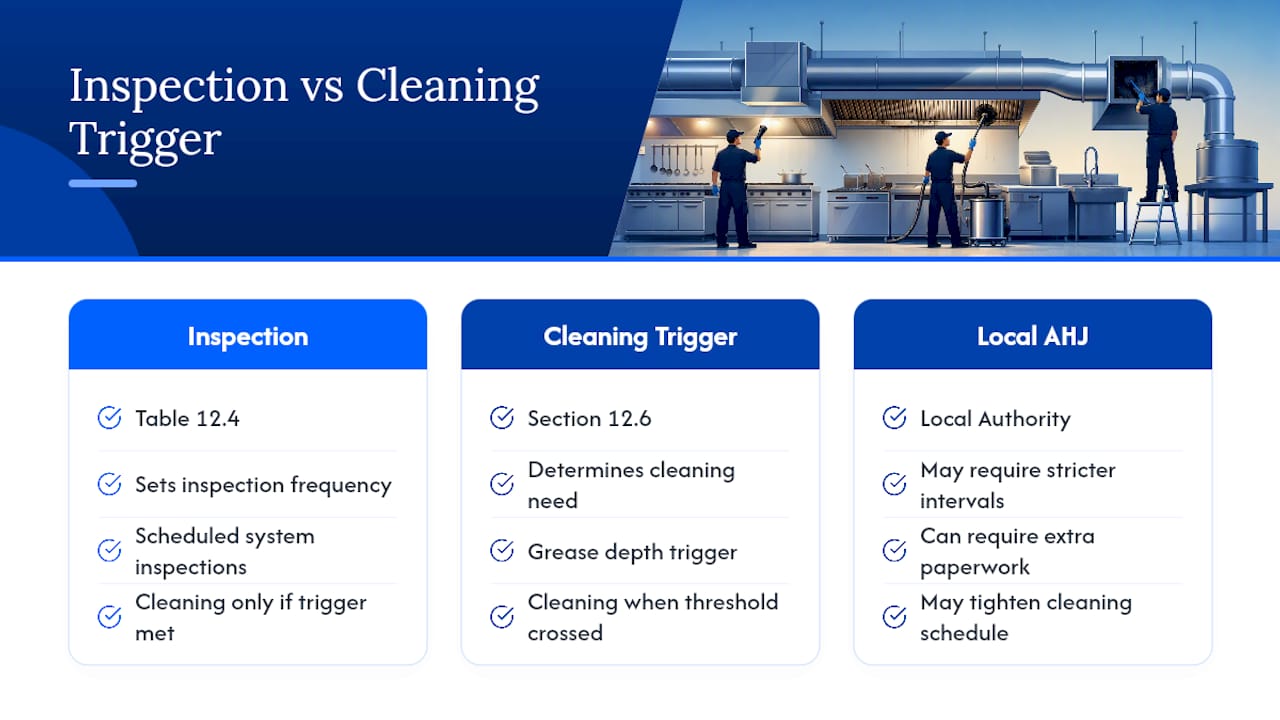
Most operators think Table 12.4 tells them when to clean. It doesn’t. Table 12.4 sets how often a qualified person has to inspect the exhaust system, and Section 12.6 is what actually forces a cleaning job. That split exists because grease buildup depends on what you cook, how much you cook, and how long the equipment runs, not on a fixed date on the calendar.
Here’s the practical version: a kitchen on a quarterly inspection tier gets checked four times a year. If the grease depth stays below threshold at every check, no cleaning is legally required that year, even though the standard is watching you closely. But in most high-volume kitchens, grease crosses the trigger every single time an inspector shows up, so the inspection cadence and the cleaning cadence collapse into the same schedule anyway.
This distinction matters for budgeting. A facility manager who assumes “quarterly inspection” means “quarterly cleaning bill” either overpays for cleanings that weren’t required or, worse, assumes the opposite and skips a cleaning that grease depth actually demanded. Get the mechanic backward and you’re either wasting money or walking into a fire marshal’s citation.
It also matters legally. NFPA 96 sets the floor. Local Authorities Having Jurisdiction can require stricter intervals or additional paperwork on top of it, so your insurance carrier or city fire marshal might hold you to a tighter standard than the national code alone requires. Always check your local requirements before you set your internal schedule.
What Inspection Tier Does Your Kitchen Fall Into?
Table 12.4 breaks kitchens into four tiers, and the assignments follow cooking volume and fuel source more than restaurant type or square footage.
- Monthly goes to solid-fuel operations: wood-fired pizza ovens, smokehouses, and charcoal grills. Solid fuel throws off grease and particulate fast, and NFPA treats these kitchens as the highest-risk category regardless of how many covers they do a night.
- Quarterly applies to high-volume cooking: 24-hour diners, heavy charbroil operations, wok stations, and any kitchen running long hours with high-heat, high-grease methods. Volume and runtime drive this tier more than menu complexity.
- Semiannual covers moderate-volume kitchens, which is where most sit-down restaurants and hotel kitchens land. Standard fryers, griddles, and ranges running normal service hours fit here.
- Annual is reserved for low-use operations: churches, seasonal concession stands, day camps, and banquet kitchens that only fire up occasionally.
Borderline cases are where operators get into trouble. A sit-down restaurant that adds a wok station or starts running a late-night menu can quietly shift from semiannual risk into quarterly territory without anyone updating the inspection contract. If your cooking volume or methods change, revisit your tier. A kitchen that expanded seasonal hours or added high-heat equipment should move to a tighter cadence before an inspector or insurer forces the issue.
The Grease-Depth Numbers That Actually Trigger Cleaning
Three numeric thresholds in Section 12.6.1.1 decide whether a cleaning is legally required, and each one applies to different surfaces in the system.
Statistic to know: NFPA 96 sets grease-depth cleaning triggers at 0.002 inches for hoods, filters, fans, and ducts; 0.078 inches for other exposed surfaces; and 0.125 inches for fan housings. Cross any one of those on the surface it applies to, and a cleaning is required.
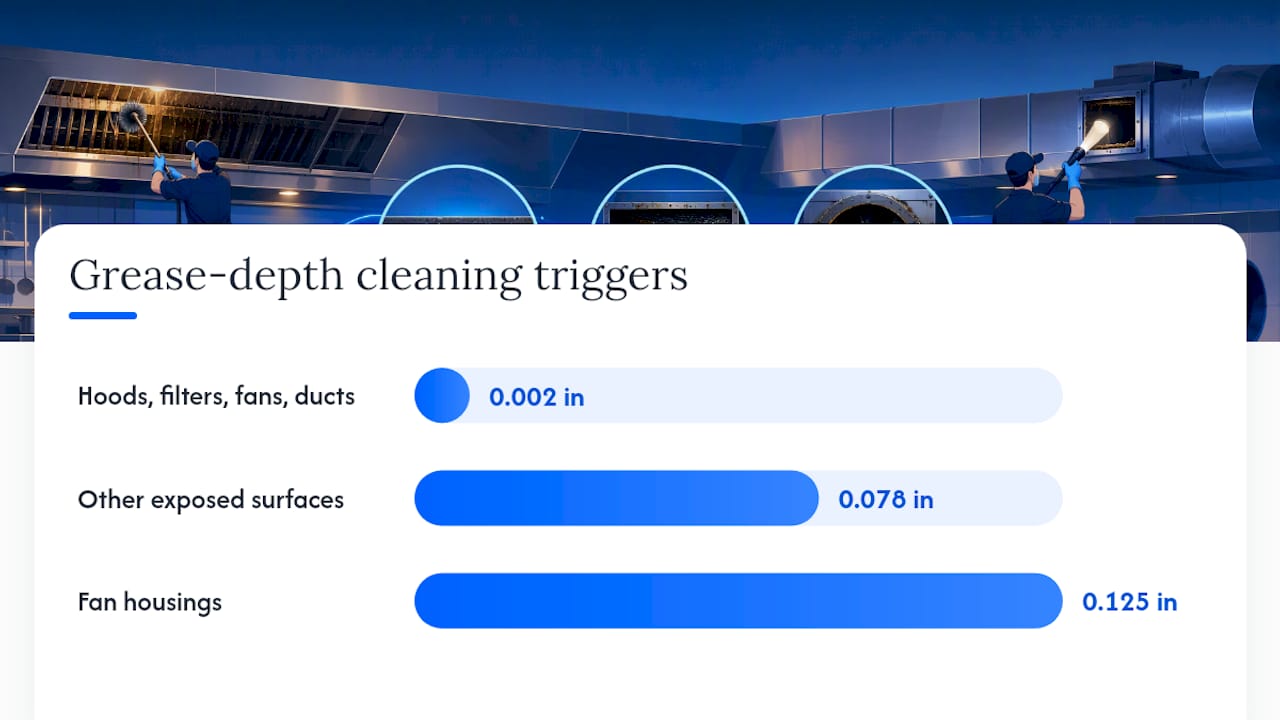
Put those numbers in perspective. The 0.002 inch threshold on hoods and ducts is close to a paper-thin film, barely visible to the naked eye but enough to feed a duct fire if ignored. The 0.078 inch threshold on broader surfaces is roughly the thickness of a couple of stacked coins. Fan housings get more tolerance at 0.125 inches because of where they sit in the airflow path, but that’s still a call for cleaning the moment a technician’s scraper or depth gauge confirms it.
A technician measures grease depth with a scraper, probe, or depth gauge at multiple points along the hood, plenum, ductwork, and fan housing, then records the readings in the inspection report. NFPA also builds in a qualitative standard alongside the numbers: surfaces should be cleaned before they reach “heavy” contamination, which gives an inspector room to call a cleaning even in a borderline case where a strict numeric reading might not quite hit threshold. Expect your report to show specific measurements, not just a checkbox that says “passed.”
What Proof Should You Keep After Every Cleaning?
A hood that looks clean and a hood that’s documented clean are two different things when a fire marshal or insurance adjuster shows up. Municipal guidance from cities like Charleston is explicit that full-system inspection, cleaning, and written reporting are what regulators expect to see, not a verbal assurance that “we cleaned it last month.”
Require these deliverables from every cleaning:
- A written inspection report with specific grease-depth notes for hoods, ducts, fans, and other surfaces.
- Before-and-after photos covering the hood, plenum, fan assembly, and rooftop grease containment.
- A service tag or sticker affixed to the hood showing the cleaning date and the next inspection due date.
Documentation carries more weight with insurers and AHJs than a vendor’s word that the job got done. When a claim gets filed after a kitchen fire, the first thing an adjuster asks for is the paper trail, and gaps in that trail can void coverage outright.
Pro Tip: Keep at least three years of inspection reports and service tags on file, and store digital copies of your photos separately from the paper reports. A fire marshal revisit or insurance audit rarely gives you more than a day or two of notice.
For a step-by-step on assembling your file before an inspector walks in, see this two-minute hood inspection prep guide.
How Do You Vet a Hood-Cleaning Provider?
The cheapest quote is usually cheap because it only covers the visible canopy. NFPA 96 requires the entire exhaust path, not just the parts a customer can see from the kitchen floor.
Ask any prospective provider for proof of IKECA certification or documented equivalent training, plus current liability insurance. Certification alone doesn’t guarantee a perfect job, but it substantially lowers the odds you get a surface-only clean that leaves ducts and fan housings loaded with grease.
Get the scope of work in writing before the crew shows up. It should explicitly name interior ductwork, fan housings, and rooftop grease containment, not just “hood and filters.” Watch for these red flags:
- Photos that only show the canopy interior, never the ducts, fans, or roof.
- No service tag left on the hood after the job.
- Reluctance to access rooftop equipment or explain how they get into the ductwork.
- No numeric grease-depth readings anywhere in the paperwork.
A provider that struggles to answer a direct question about rooftop containment access probably isn’t equipped to service it. Facility managers juggling multiple properties should read up on matching containment systems to kitchen output before signing a service contract.
What a Complete Compliance Job Looks Like
Full-system hood degreasing services with commercial-grade equipment and insured crews are offered, with quotes available on a timely basis so operators aren’t stuck waiting weeks past their inspection deadline. Every job includes before-and-after photos, a service tag with the next inspection date, and a written report built for AHJ or insurance review.
If you’re writing a purchase order for a cleaning, require these minimum acceptance criteria in the contract language: full duct and fan access, rooftop containment service, numeric grease-depth documentation, and a dated service tag left on-site. Anything less leaves you exposed at your next inspection.
Why Operators Keep Getting This Wrong
The mistake I see most often is operators accepting a canopy-only clean and calling it compliant, then getting blind sided when a fire marshal checks the ductwork. Weak documentation is the second-biggest failure. A verbal “we cleaned it” means nothing to an insurance adjuster after a fire.
Solid-fuel kitchens deserve extra caution. Grease builds up faster there than most owners expect, and high season can push you past threshold between scheduled inspections. Plan your budget for that reality, not the calendar.
— Brandon
Get an NFPA 96 Compliant Hood Cleaning Quote
Most hood-cleaning outfits will scrub the visible canopy and call it a day, leaving your ducts, fan housing, and rooftop containment exactly as greasy as before. The full exhaust path is serviced instead: hood, plenum, ductwork, fan housing, and rooftop containment, backed by commercial-grade equipment and insured crews.

Every job comes with the documentation your fire marshal or insurer actually wants to see: before-and-after photos, a written report with grease-depth notes, and a service tag showing your next inspection due date. Same-week quotes mean you’re not stuck waiting weeks past a deadline while your grease depth keeps climbing. Restaurant owners and facility managers in the Denver metro can request a quote for hood degreasing in Denver directly, or check service details and coverage areas for Colorado Springs and Denver first. If you want to see how past jobs turned out before booking, read recent customer reviews.
Where to Verify NFPA 96 Text and Certification Standards
Read the actual code language through NFPA’s free online access program, which lets you view (though not print) the current edition. Confirm a technician’s credentials on IKECA’s certification page, and check your city or county fire marshal’s site for any local rules stricter than the national floor.
Sources
- Standard for Ventilation Control and Fire Protection of Commercial Cooking Operations — NFPA
- How Often Should You Clean Your Commercial Kitchen Exhaust System? (2026 Compliance Guide to NFPA 96)
- Commercial Kitchen Exhaust Hood Inspection & Cleaning — Charleston SC
- IKECA — International Kitchen Exhaust Cleaning Association
FAQ
How often do commercial hoods need to be cleaned?
Cleaning frequency depends on your inspection findings, not a fixed schedule. NFPA 96 requires cleaning whenever measured grease exceeds the thresholds in Section 12.6.1.1, which for many high-volume kitchens often lines up with every scheduled inspection.
What are the NFPA 96 requirements for inspection frequency?
NFPA 96’s Table 12.4 sets four tiers: monthly for solid-fuel cooking, quarterly for high-volume operations like 24-hour diners and wok stations, semiannually for moderate-volume sit-down restaurants, and annually for low-use kitchens like seasonal concession stands.
What is the difference between inspection and cleaning under NFPA 96?
Inspection cadence is scheduled by kitchen type under Table 12.4. Cleaning is only required when that inspection finds grease depth over the numeric threshold for the surface in question, such as 0.002 inches on hoods and ducts.
How often should I clean my kitchen exhaust fan?
Exhaust fans and fan housings get inspected on the same cadence as the rest of the hood system, but cleaning is triggered separately when grease on the fan housing reaches the 0.125 inch threshold under NFPA 96.
What should I ask a hood cleaning company to prove compliance?
Ask for IKECA certification or equivalent training, proof of insurance, and a completed job that includes a written report with grease-depth notes, before-and-after photos, and a dated service tag showing the next inspection due.