

Stop Warranty Voids: Match Commercial Building Washing to Substrate
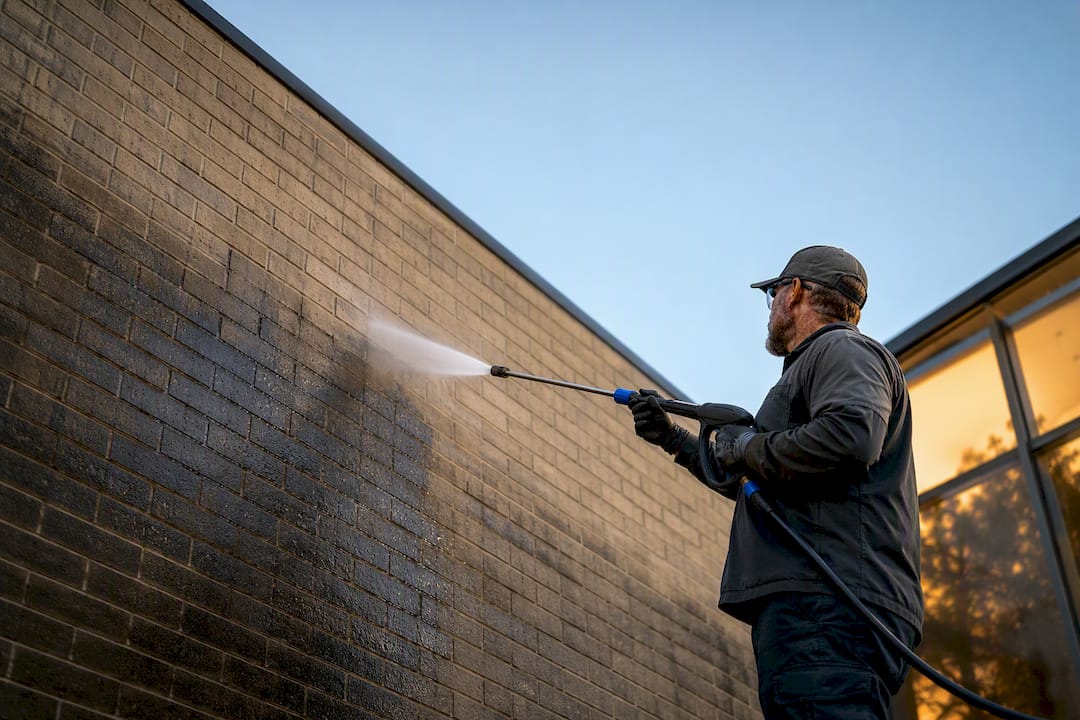
For most mixed-material commercial facades, start with a substrate-aware soft wash and save high-pressure or heated-power washing for hard, uncoated surfaces or stubborn oil and grease stains. If your building rises above one story, mixes stucco with metal or glass, or carries a warranty you can’t afford to void, call a licensed pro before anyone points a wand at the wall.
TL;DR:
- Soft washing with chemistry is safest for stucco and EIFS, while high-pressure or heated power washing can damage these materials and should be avoided.
- Proper substrate assessment is critical, as masonry can tolerate higher pressure, but mortar joints and softer bricks degrade quickly under high PSI.
- Chemical dwell time is vital; sodium hypochlorite solutions need 5 to 15 minutes to effectively remove organic growth, with rushing risking incomplete cleaning.
- Access methods like lifts, poles, or drones must match building height and material complexity to ensure safety and efficiency.
- Hiring a licensed professional with a substrate-specific cleaning plan, insurance, and proper equipment prevents damage, especially on mixed-material or higher buildings.
Table of Contents
- What Are the Main Building Washing Methods?
- Which Method Works Safely on Each Building Material?
- What Cleaning Chemicals and Dwell Times Matter Most?
- How Do Equipment and Access Choices Affect Results?
- When Should You Hire a Professional Instead of DIY?
- What Determines Timeline and Cost for a Washing Project?
- How Does All Day Power Washing Approach Building Washing?
- Ready to Get Your Building Washed the Right Way?
- Sources
What Are the Main Building Washing Methods?
Every building washing method relies on one of three forces: mechanical impact, heat, or chemistry. Pick the wrong one for the surface and you trade a dirty building for a damaged one.
Pressure washing uses cold water forced through a nozzle at high PSI, usually 3,000 to 4,000 for commercial equipment. It’s mechanical brute force, great for concrete, uncoated brick, and metal, but rough on anything porous or painted.
Power washing is functionally the same equipment with a heating element added. Heated water cuts through grease and oil that cold water alone won’t touch, which is why loading docks and dumpster pads usually call for power washing over standard pressure washing.
Soft washing drops the pressure to under 500 PSI and does the actual cleaning with chemistry, typically a sodium hypochlorite blend that kills algae, mold, and lichen at the root. It’s the default for stucco, EIFS, painted siding, and roofing.
Beyond those three, a few specialized methods fill specific gaps:
- Steam cleaning uses high-temperature vapor for grease-heavy surfaces like kitchen exhaust systems, where NFPA-96 compliance demands thorough degreasing without flooding equipment.
- Water-fed pole systems clean upper-story glass using purified water fed through a telescoping pole, leaving no spotting because there are no minerals left behind to dry into streaks.
- Drone-assisted washing delivers soft-wash chemistry or low-pressure rinses to high-rise facades without scaffolding, a fast-growing option for buildings where lift access is expensive or restricted.
Match the method to the material first. Everything else, including how fast the crew works, is secondary.
Which Method Works Safely on Each Building Material?
Substrate compatibility is where most washing jobs go wrong, and it’s almost always the same mistake: someone runs high pressure on a surface built to shed dirt, not absorb a direct blast of water.
- Stucco and EIFS need soft washing exclusively. High pressure drives water behind the finish coat, causing bubbling, cracking, and mold growth you won’t see until it’s structural. FCPE’s commercial washing guidance treats soft-wash chemistry as the baseline for both materials.
- Fiber cement (Hardie board) tolerates moderate pressure but soft washing extends the paint’s lifespan and avoids stripping the factory finish.
- Painted concrete block should get soft washing. Pressure lifts paint at seams and corners first.
- Brick and unpainted masonry can handle higher pressure, but the GSA’s technical guidelines warn that mortar joints and older, softer brick erode fast under high PSI.
- Metal siding and railings handle pressure washing well, though heated power washing clears baked-on residue faster.
- Glass should never see direct pressure spray; water-fed pole systems are built for it.
- Concrete pads and driveways are the one surface where pressure washing is almost always the right call.
A quick substrate survey before quoting, walk the perimeter, note every material transition, saves callbacks and change orders once work starts.
What Cleaning Chemicals and Dwell Times Matter Most?
Chemistry does the real work in soft washing, and dwell time is what separates a clean building from a rinsed one. Sodium hypochlorite solutions need contact time, often 5 to 15 minutes depending on concentration and growth density, to break down algae and mildew at the cellular level before rinsing.
Professionals typically choose from a few chemical categories:
- Sodium hypochlorite blends for organic growth (algae, mold, lichen)
- Oxalic acid for rust and mineral staining, common on metal-adjacent stucco
- Degreasers for kitchen hoods and loading docks, paired with hot water where NFPA-96 compliance is on the line
- Biodegradable surfactants for landscaped areas and stormwater-sensitive sites
Downstream chemical injection, where the cleaner is metered into the water stream near the nozzle rather than pumped directly, protects pump seals and gives crews finer control over concentration.
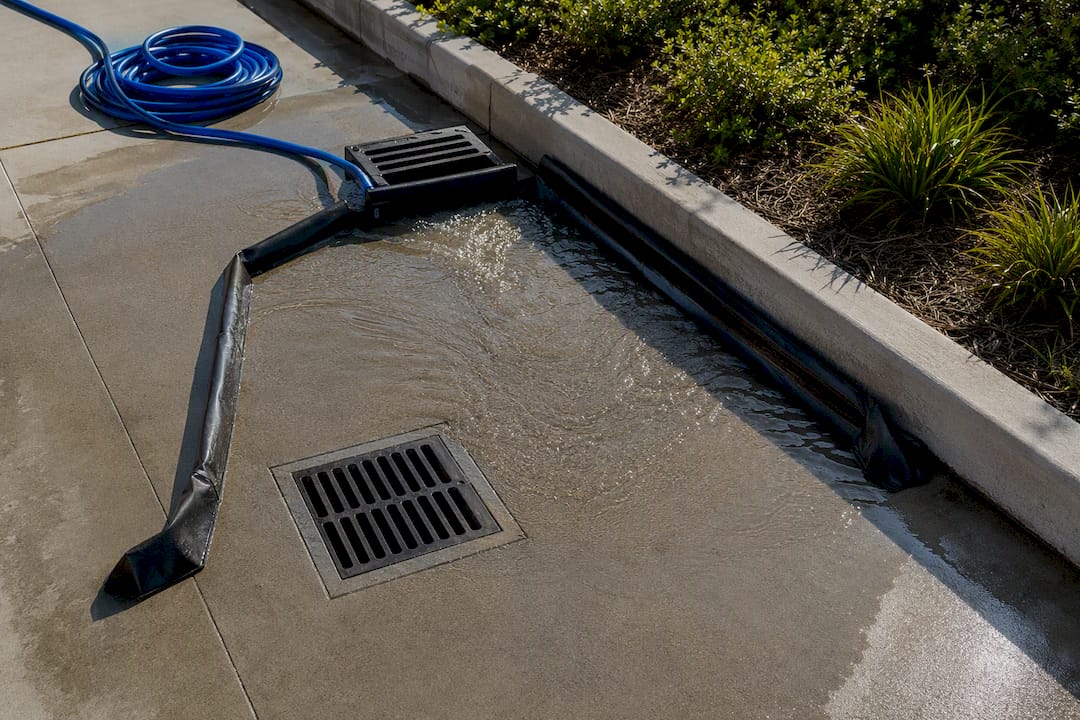
Runoff matters as much as the chemistry itself. Covering storm drains, using biodegradable products near landscaping, and containing wash water on hardscape all reduce environmental impact and keep a job compliant with local water regulations.
Pro Tip: Ask any bidder how long they let chemical dwell before rinsing. A crew that rinses within two minutes on a heavy-growth building either doesn’t know the chemistry or is rushing the job.
How Do Equipment and Access Choices Affect Results?
PSI gets the attention, but flow rate (measured in gallons per minute) and nozzle selection matter just as much. A 4,000 PSI machine with a narrow 0 degree tip concentrates enough force to etch stucco; the same machine with a 40 degree fan tip and lower flow spreads that force safely across brick.
Access method shapes both safety and cost:
- Telescoping poles work for single and two-story buildings without needing a lift on-site.
- Boom lifts handle mid-rise commercial facades but require clear ground access and traffic control around the lift’s footprint.
- Rope access suits tight urban sites where a lift can’t maneuver, though it demands certified technicians and adds scheduling time.
- Drone-assisted systems now reach high-rise facades using downstream chemical injection and rotary nozzles, cutting scaffolding costs and fall risk, though pressure loss at elevation forces careful nozzle selection to maintain cleaning power.
Research on automated high-pressure cleaning systems confirms that nozzle type, spray angle, and standoff distance directly determine cleaning performance and safety margins, the same variables a human operator adjusts by feel on every job.
When Should You Hire a Professional Instead of DIY?
Height, mixed substrates, and warranty exposure are the three signals that mean call a pro, not rent a machine. A two-story building with stucco, metal trim, and glass in the same elevation isn’t a DIY afternoon; it’s three different methods applied in the right sequence.
Before hiring anyone, verify:
- Certificate of insurance covering both liability and workers’ compensation.
- A written, substrate-aware cleaning plan naming the method for each material, not a single blanket approach.
- OSHA-aligned access documentation for any job involving lifts, poles above a certain height, or rope access.
- Before-and-after photos and a written condition report, which protects both parties if a dispute comes up later.
- References from comparable commercial jobs, not just residential house-washing reviews.
Improper high-pressure cleaning is a common enough problem that GSA maintains standing technical procedures just to prevent it on masonry alone. A crew that can’t produce insurance paperwork or a substrate plan on request is a red flag worth walking away from, no matter how sharp the quote looks.
What Determines Timeline and Cost for a Washing Project?
Facade square footage and story count drive the estimate more than anything else, but substrate mix runs a close second, a building with four material types takes longer than one with two, even at the same square footage.
Other cost drivers worth knowing before you compare quotes:
- Access needs (ground-level pole work costs far less than boom lift or rope access)
- Prep and traffic control for occupied commercial sites
- Degree of buildup (first-time washes after years of neglect take longer than annual maintenance)
A small single-story retail strip might run a few hours; a mid-rise facade can take a full day or more, and drone-assisted high-rise jobs vary widely depending on elevation and chemical dwell requirements. Most reputable contractors won’t quote a firm price without an on-site or video walk-through first, and that’s a good sign, not a delay tactic.
How Does All Day Power Washing Approach Building Washing?
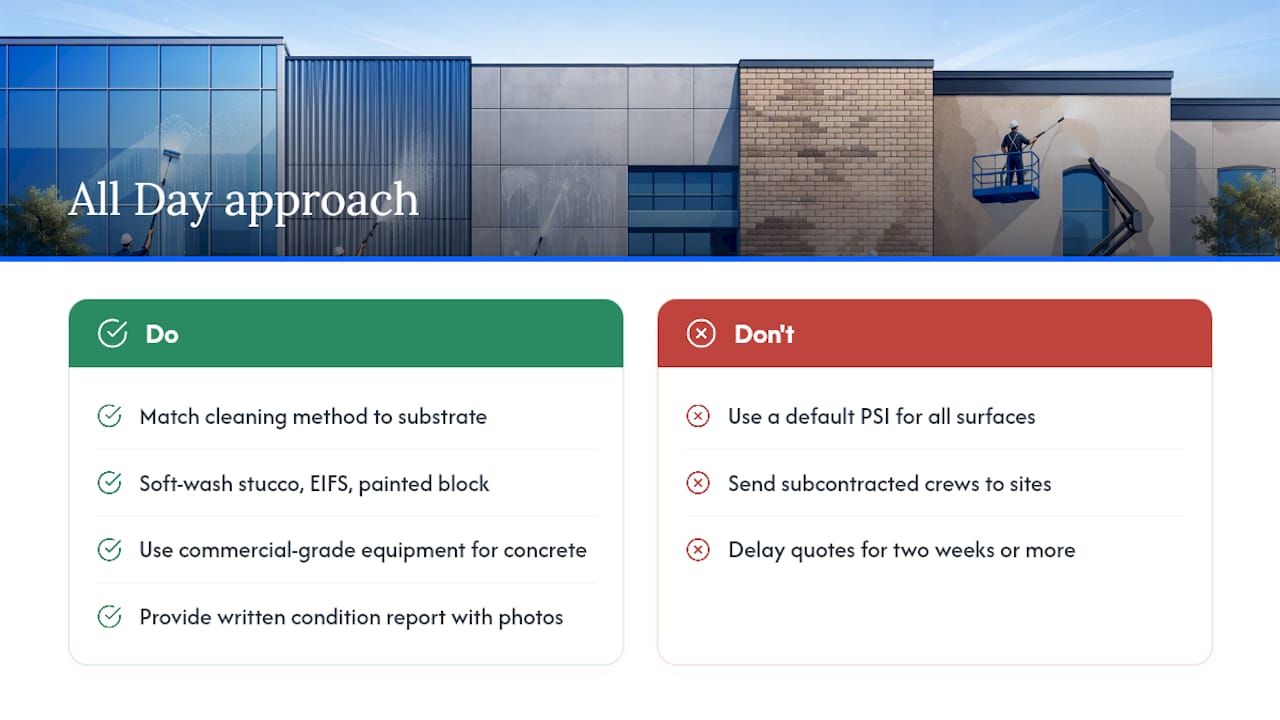
We build every commercial quote around the substrate, not a default PSI setting. That means a soft-wash-first plan for stucco, EIFS, and painted block, commercial-grade equipment reserved for concrete and hard surfaces, and a written condition report with before-and-after photos on every job.
All Day Power Washing carries full insurance, sends real crews (not subcontracted strangers) to every site, and turns around same-week quotes for property managers who can’t wait two weeks for a bid. If you want to see how we sequence methods across mixed materials, our guide to low-pressure house washing walks through the same substrate-first logic we apply on commercial sites.
— Brandon
Ready to Get Your Building Washed the Right Way?
Reading about soft-wash chemistry and boom lift logistics is one thing. Getting a crew that actually applies it correctly to your building is another. All Day Power Washing is the option that skips the guesswork entirely: we scope your building’s specific substrate mix before we quote a number, not after we’ve already started spraying.

That means a stucco and metal building gets two different treatments in the same visit, a kitchen hood gets NFPA-96 degreasing instead of a generic rinse, and a parking structure gets the pressure it can actually handle. We’re fully insured, we send commercial-grade equipment and real crews to every job in Colorado Springs and the Denver metro, and we back the work with a satisfaction guarantee. If your property mixes materials or sits above one story, that scoping step is the difference between a clean building and a repair bill.
Request a same-week quote for Denver-area properties and get a substrate-specific plan before any equipment shows up on-site.
Sources
- Local Power Washing & Exterior Cleaning Experts Near You | Neighborly
- Automated technique for high-pressure water-based window cleaning and accompanying parametric study | PLOS ONE