

Manufacturer Aligned Epoxy Floor Routine: pH, Dilution, When to Hire
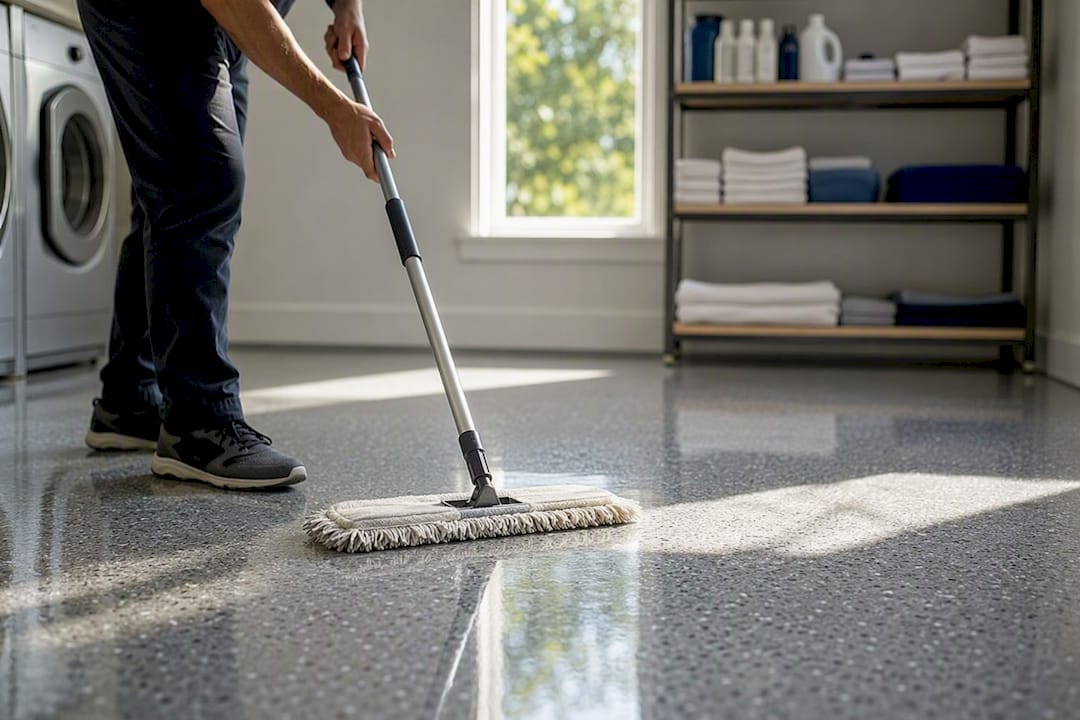
Sweep daily, damp-mop weekly with a pH-neutral cleaner or mild dish soap diluted 1 to 3 ounces per gallon of warm water, wipe up spills the moment they happen, and schedule a deeper scrub every month or quarter. Stay in the pH 6 to 9 range and skip anything acidic or heavily alkaline. That routine alone prevents most of the dulling, staining, and etching that sends epoxy garage floors into early recoat territory. For grease-soaked commercial pads or floors that need mechanical prep before a recoat, All Day Power Washing handles the heavy lifting.
TL;DR:
- Regular sweeping and damp-mopping with pH 6 to 9 cleaners prevent dulling and staining that can lead to early recoat needs.
- Monthly or quarterly deep cleaning involves a five-step process using soft brushes and rinsing to avoid film buildup.
- Avoid acidic, abrasive, or solvent-based cleaners, which can damage the epoxy coating and void warranties.
- Address stains like grease, tire marks, rust, or scuffs promptly with appropriate non-abrasive methods to prevent permanent damage.
- Large-scale grease spills or delamination issues require professional cleaning and mechanical preparation to ensure proper repair.
Table of Contents
- What is the right epoxy floor maintenance schedule?
- What is the best cleaner for epoxy floors?
- How do you remove stains and marks from epoxy floors?
- What tools should you use to clean an epoxy garage floor?
- When does an epoxy floor need repair instead of routine cleaning?
- When should you call in a professional for epoxy floor care?
- Prevention beats repair almost every time
- Get Professional Help With Epoxy Floor Deep Cleaning and Recoats
- Sources
What is the right epoxy floor maintenance schedule?
Grit is the enemy. Every pebble, sand grain, and stray piece of gravel tracked in on a shoe or tire acts like sandpaper under foot traffic and rolling weight, and that’s what dulls the topcoat’s gloss faster than anything else. A daily sweep or dry-mop with a soft-bristle broom or microfiber dust mop clears that grit before it gets ground in.
Weekly, damp-mop the floor with warm water and a pH-neutral cleaner or diluted mild dish soap. Work in sections rather than trying to cover the whole floor in one pass to avoid the cleaning solution drying on the surface and leaving a hazy residue film.
Monthly or quarterly, depending on traffic, do a deeper scrub. Soft-bristle brushes work for a two-car garage. Larger commercial floors call for an auto-scrubber. Manufacturer guidance from Sherwin-Williams frames this as a five-step cleaning process, and it’s worth following in order:
- Sweep the area first to remove loose debris.
- Apply the cleaning solution evenly across the section.
- Agitate with a soft pad, brush, or scrubber.
- Dwell for 3 to 10 minutes so the solution has time to lift soil.
- Remove the solution with a mop, wet vac, or clean rinse water.
Rinse when you’ve used anything beyond plain water, even a mild soap dilution. Skipping the rinse is how that dull, streaky film builds up over a few months of otherwise diligent cleaning.
What is the best cleaner for epoxy floors?
Default to a pH-neutral cleaner, somewhere in the 6 to 9 range, or a mild dish soap diluted at 1 to 3 ounces per gallon of warm water. That ratio cuts light dirt and residue without leaving the topcoat cloudy or stripped of its sheen.
Dilution reference: 1 to 3 ounces of mild dish soap or pH-neutral cleaner per gallon of warm water, kept within pH 6 to 9, is the range Mr Terrazzo’s cleaning guidance recommends for everyday epoxy cleaning.
A mild alkaline degreaser can work for areas with persistent grease, but only if the epoxy system’s manufacturer has approved it for that coating. Opora’s field guide on epoxy floor care treats a neutral-cleaner-only program as the low-risk default, reserving stronger degreasers for cases the manufacturer signs off on. Anything above pH 11, or any solvent-based product, risks softening or clouding the topcoat.
Cleaners to keep off your epoxy floor entirely:
- Vinegar or citrus-based cleaners, which are acidic enough to etch the surface over repeated use.
- Abrasive powders or scouring cleansers, which scratch the topcoat at a microscopic level.
- Solvent-based cleaners and unspecified concrete strippers, which can break down the resin itself.
- Anything not on the epoxy system manufacturer’s approved cleaner list, since using it can void a coating warranty.
That last point matters more than most owners realize. Warranty language on commercial epoxy systems often ties directly to the cleaning products used, so it’s worth pulling that approved list before your maintenance crew grabs whatever’s under the sink.
How do you remove stains and marks from epoxy floors?
Different contaminants need different handling, and using the wrong method can make a stain permanent instead of removing it.
- Oil and grease: Blot up excess liquid first, never wipe it around. Apply an epoxy-safe degreaser, agitate gently with a soft pad, then rinse and dry the area completely.
- Tire marks and hot-tire pickup: Use a soft pad with a pH-neutral cleaner, and reach for isopropyl alcohol on stubborn rubber transfer. Letting tires cool before parking, or using mats under them, prevents the problem before it starts.
- Rust: Reach for an epoxy-safe rust remover and go easy on the agitation. Skip homemade acid-based recipes. They can etch the topcoat while barely touching the rust.
- Scuffs and rubber burns: Start with routine cleaning; many scuffs lift with a pH-neutral solution alone. If that fails, a plastic scraper or non-abrasive pad works. Carboline’s maintenance guidance specifically calls out targeted cleaning and agitation for rubber burns rather than harsh scrubbing. Never use a wire brush; it will scratch through the coating.
Hot-tire pickup deserves special attention if you park the same vehicle in the same spot daily. Prevention measures for tire-related damage go a long way toward avoiding the problem in the first place.
What tools should you use to clean an epoxy garage floor?
For a residential garage, a basic kit covers nearly everything: a soft-bristle broom, a microfiber dust mop for daily grit removal, a microfiber flat mop or soft foam mop for weekly damp-mopping, and white or gray scrub pads for stubborn spots.
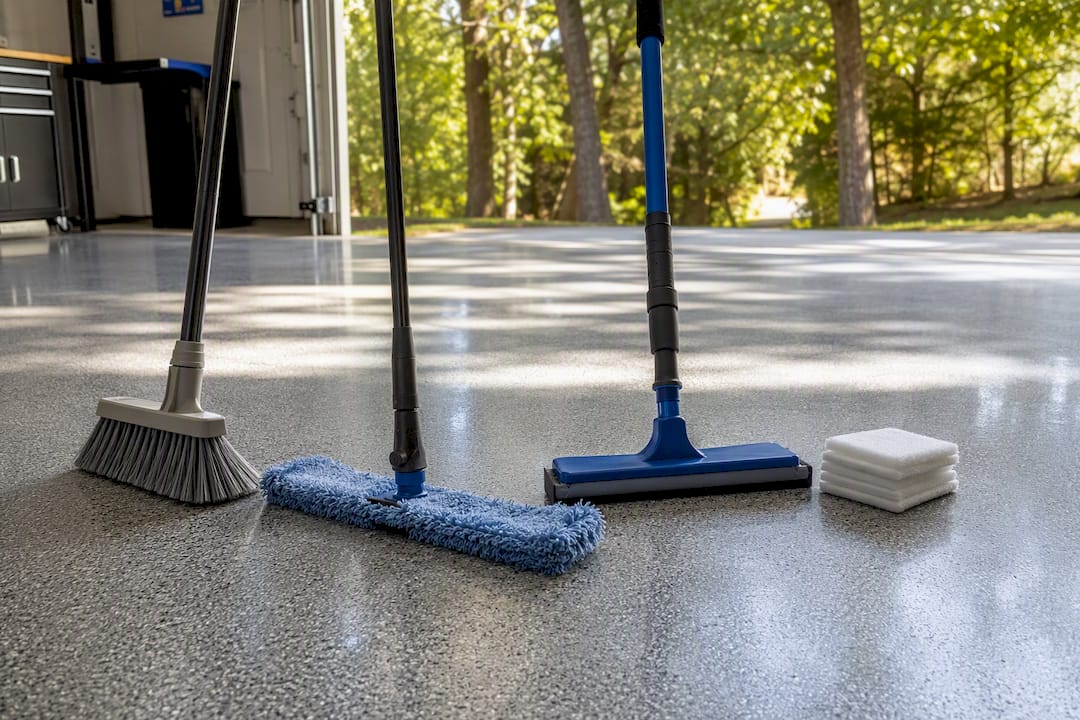
Commercial spaces need more capacity. An automatic floor scrubber fitted with a white or tan pad handles large square footage efficiently, paired with a soft squeegee, a wet vac for pickup, and foam or flat mops for finishing touches. Pad color matters here. Whites and tans are gentle enough for daily cleaning, while more aggressive pads can dull the topcoat over time.
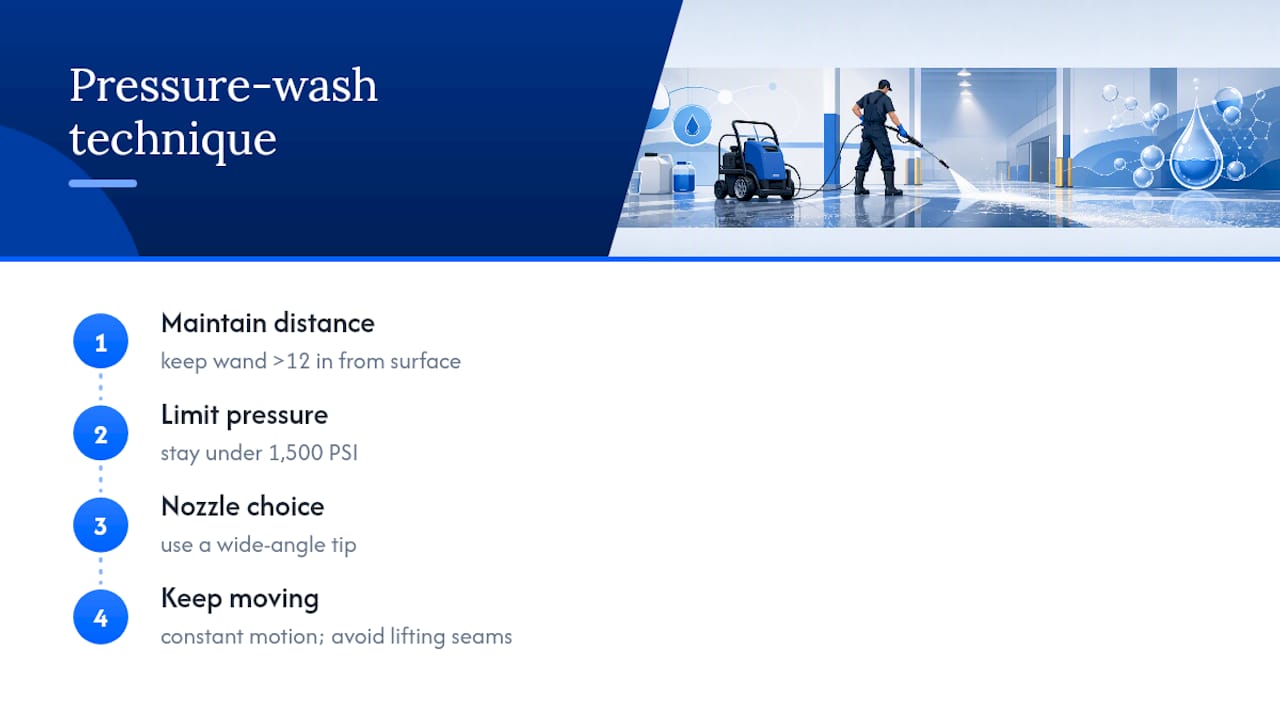
Pressure washers can be used, but only with care. Keep the wand more than 12 inches from the surface, use a wide-angle tip, and stay under 1,500 PSI. Low pressure and constant motion prevent lifting a weak seam or edge, which is exactly where delamination tends to start.
Pro Tip: Skip string mops entirely. They shed lint that sticks to the epoxy, and they pool water in low spots instead of picking it up cleanly. A microfiber or foam mop does the job better and leaves no residue behind.
When does an epoxy floor need repair instead of routine cleaning?
Delamination, topcoat wear-through, chemical staining, and cracking at control joints are the four failure modes worth watching for. Delamination usually traces back to moisture trapped under the coating or a weak original bond. Wear-through comes from years of foot and tire traffic grinding the same paths. Staining often means a spill sat too long or the wrong cleaner etched the surface.
Run a quick inspection on a regular basis and watch for these signals:
- Visible primer or bare concrete showing through the topcoat.
- Bubbling or soft spots that weren’t there a month ago.
- Peeling or lifting at edges and seams, a sign of adhesion loss.
- Stains that keep resurfacing no matter how you clean them.
Small chips or scratches usually just need a spot repair. Widespread wear or adhesion failure calls for mechanical prep, typically diamond grinding, before a full recoat, since chemical stripping alone won’t create a strong enough bond. For larger jobs, a moisture vapor test before recoating catches the kind of subsurface moisture that would otherwise doom a new topcoat within a year. Base the recoat timeline on what the floor actually shows, not a fixed number of years.
When should you call in a professional for epoxy floor care?
Large grease spills, visible delamination, or heavy industrial soil are the moments to bring in a crew rather than working through it with a mop bucket. Mechanical prep ahead of a recoat also isn’t a DIY-friendly job. All Day Power Washing runs commercial-grade equipment with insured crews, backs the work with a satisfaction guarantee, and turns around quotes the same week. For prep guidance before you commit to a recoat, our garage floor prep breakdown covers what actually matters.
Prevention beats repair almost every time
Most epoxy damage traces back to skipped sweeping and the wrong cleaner, not bad luck, as explained in epoxy floor coating basics every DIYer should know. A walk-off mat at the entry and five minutes of daily sweeping outperform any deep-clean product on the shelf. Fix the habit before you fix the floor.
— Brandon
Get Professional Help With Epoxy Floor Deep Cleaning and Recoats
Some maintenance jobs are fine to handle with a mop and a Saturday afternoon. Others, like stripping years of grease buildup off a commercial shop floor or grinding down a worn topcoat before a recoat, need equipment and manpower most property owners don’t have on hand. That’s where All Day Power Washing steps in as the option for jobs beyond routine upkeep.

All Day Power Washing brings commercial-grade equipment and insured crews to deep-clean grease-laden floors, handle mechanical prep for recoating, and apply new epoxy coatings in solid, metallic, or flake finishes across Colorado Springs and Denver. Every job comes with a satisfaction guarantee, and quotes typically turn around the same week you request one. If your epoxy floor needs more than a weekly mop, get a quote for Denver-area service and find out what a professional deep clean or recoat prep actually costs for your space.
Sources
- What do you wash epoxy floors with? — Mr Terrazzo
- General Floor Care, Cleaning and Maintenance Guide — Sherwin-Williams
- 6 Tips to ensure proper epoxy floor coating maintenance — Carboline
- Epoxy-coated concrete floor care playbook — Opora