

Property Managers: Storefront Sidewalk Cleaning to Prevent Slip Claims
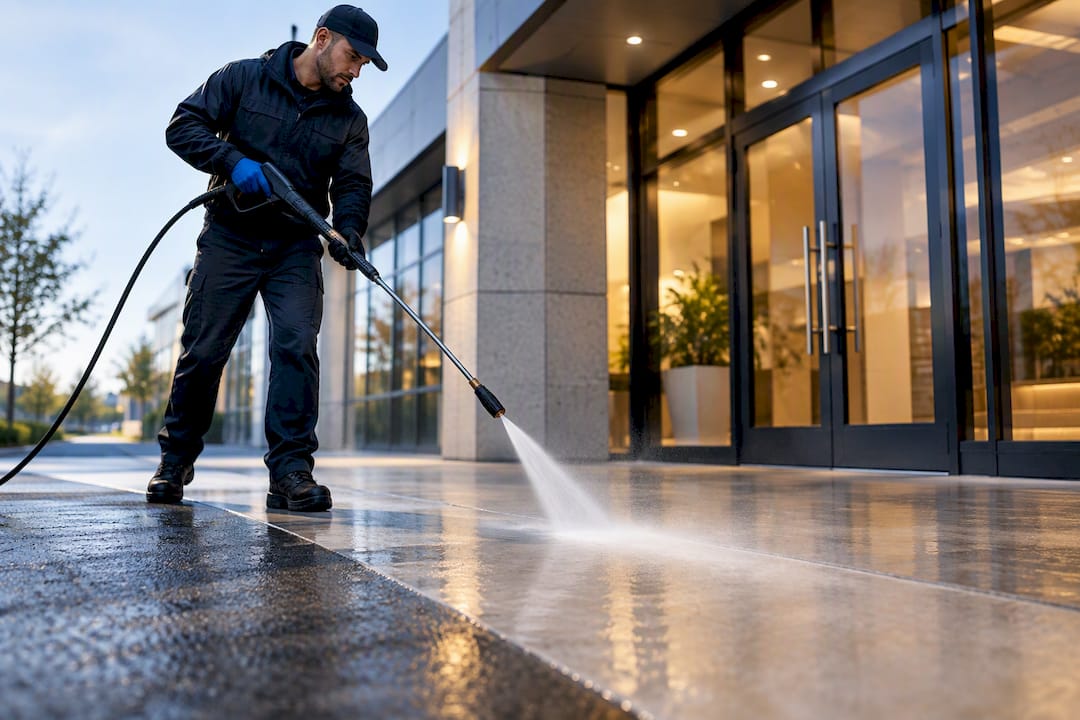
Professional storefront sidewalk cleaning strips away gum, grease, algae, and salt film that turn customer entrances into slip hazards and eyesores, as part of regular commercial cleaning services. Hire a crew when foot traffic has left visible grime or your insurance carrier flags a fall risk, and expect the work scheduled before open or after close, with cones and barriers keeping pedestrians clear.
TL;DR:
- Hot water and degreasers are essential for effectively removing grease and oil stains from sidewalks, especially in drive-thru and restaurant areas.
- Proper gum removal relies on controlled heat or scraping techniques to avoid pitting and damage to the concrete surface.
- Work should be scheduled before opening or after hours with clear traffic control and ADA access maintenance to prevent disruptions and hazards.
- Cost estimates vary based on soil type, access, and wastewater handling, so detailed quotes should include all scope and equipment specifics.
- Regular cleaning frequencies depend on soil load, with monthly for grease-prone entrances and quarterly to biannual for moderate retail areas, to prevent extensive buildup.
Table of Contents
- What Storefront Sidewalk Cleaning Removes and Why It Matters
- Which Cleaning Methods and Equipment Actually Work
- How Do Contractors Schedule Work Around Business Hours?
- What Should Be in a Storefront Cleaning Quote?
- How Much Does Storefront Sidewalk Cleaning Cost?
- How Often Should You Clean a Storefront Sidewalk?
- What to Verify Before Hiring a Storefront Cleaning Crew
- An Editorial Note on Getting This Right
- Get a Same-Week Quote for Your Storefront
- Sources
- FAQ
What Storefront Sidewalk Cleaning Removes and Why It Matters
Every entrance collects a specific mix of grime, and knowing which one you’re dealing with changes both the cleaning method and the urgency. Gum flattens into concrete pores under thousands of footsteps. Grease from restaurant vents drifts onto pavers and turns them into a skating rink after rain. Algae grows in shaded, north-facing walkways. Salt and ice-melt residue leaves a gray film that eats at concrete over a Colorado winter.
- Gum and food/beverage stains: cosmetic but slippery once softened by heat or moisture
- Grease and cigarette residue: high slip risk near restaurant entries and smoking areas
- Algae and mildew: common in shaded walkways, worsens traction in wet weather
- Salt and traffic film: gray haze from ice melt and vehicle exhaust, corrosive over time
Most of this is a cleaning job, not a repair. Spalled concrete, cracked joints, or heaved slabs are structural issues a pressure washing crew will flag, not fix. Under OSHA’s walking-working surfaces standard, employers are required to correct or guard hazards like these, which puts routine cleaning squarely in the maintenance category rather than a nice-to-have.
Which Cleaning Methods and Equipment Actually Work
A surface cleaner, the flat spinning-nozzle attachment, delivers even coverage across wide sidewalk slabs without the striping a handheld wand leaves behind. Wands still earn their place around tight corners, door frames, and signage where a surface cleaner can’t reach.
Hot water matters more than most managers assume. Cold water rinses surface dirt; hot water at 180 to 200 degrees breaks down grease molecules at a drive-thru window or restaurant pad in a fraction of the passes cold water would need. Degreasers handle the rest, but they need to match the surface. Brick, stucco, painted trim, and decorative pavers can pit or fade under high-pressure hot water, which is why a soft-wash approach, lower pressure with a longer chemical dwell time, protects those surfaces while still lifting the stain.
- Surface cleaners for open sidewalk runs and plazas
- Hand wands for edges, signage, and detail work
- Hot water and degreasers for grease, drive-thru pads, and oil stains
- Soft-wash chemistry for brick, stucco, pavers, and painted surfaces
- Heat-based or scraper gum removal that lifts without pitting the concrete
Pro Tip: Ask any contractor how they handle wastewater before you ask about price. Detergent and grease runoff that hits a storm drain untreated is exactly the kind of thing local stormwater rules exist to catch, and a crew without a containment or recovery plan is a liability you don’t want attached to your property.
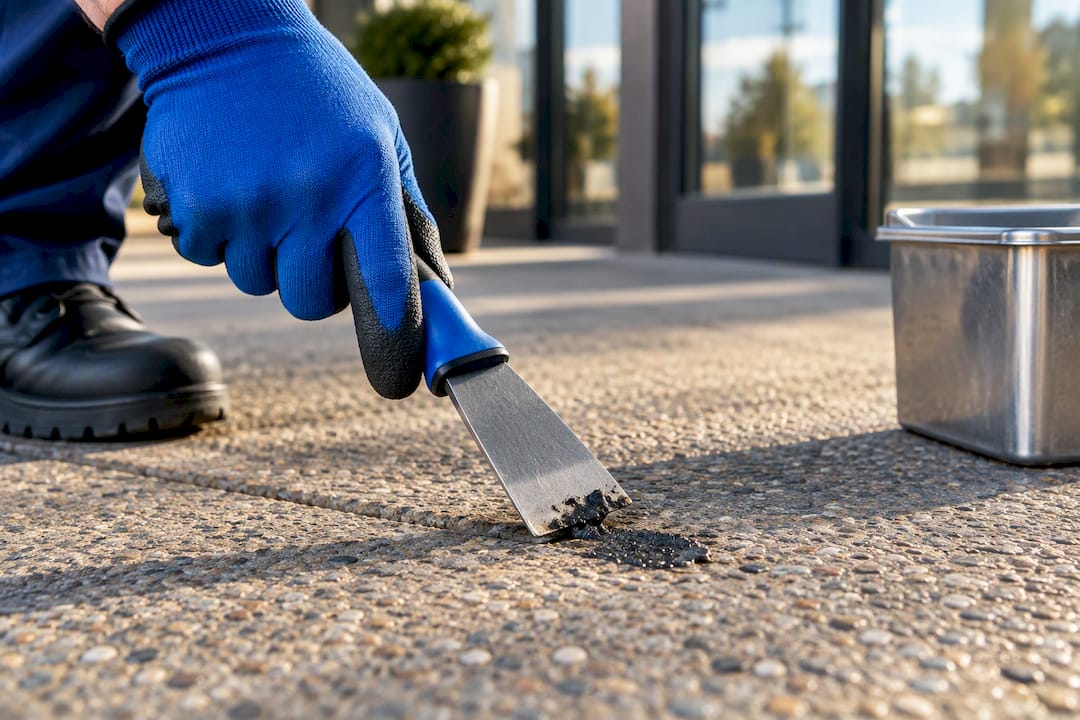
For gum specifically, the technique matters as much as the tool. Proper gum removal uses controlled heat or scraping rather than brute-force pressure, which avoids the pitting that turns a clean sidewalk into a permanently scarred one.
How Do Contractors Schedule Work Around Business Hours?
Storefronts don’t get the luxury of shutting down for cleaning, so the work happens around you, not through you. Most crews propose one of two windows: before the doors open or after the last customer leaves. Either way, the goal is zero disruption to sales.
- Confirm the work window. Early morning avoids overnight temperature drops that slow drying; late night avoids daytime foot traffic entirely.
- Set up traffic control. Cones, signage, and temporary barrier routing direct pedestrians around wet sections while keeping at least one dry, accessible path open at all times.
- Maintain ADA access. A crew should never block the only compliant route to an entrance, even mid-job.
- Run the reopening check. Before handing the space back, a contractor should confirm the surface is dry, check for pooling near drains, and photograph the finished area for your records.
- Flag special zones separately. Drive-thru lanes, dumpster pads, and loading areas often need short closures rather than just cones, since hoses and equipment cross active paths there.
That dry-path requirement isn’t just about slip risk in the moment. A walkway reopened too soon, with hoses still crossing it or standing water near an entrance, creates the exact hazard OSHA’s standard is written to prevent.
What Should Be in a Storefront Cleaning Quote?
Ask five vendors for a quote and you’ll often get five different scopes disguised as five different prices. The fix is sending every contractor the same checklist so you’re comparing apples to apples.
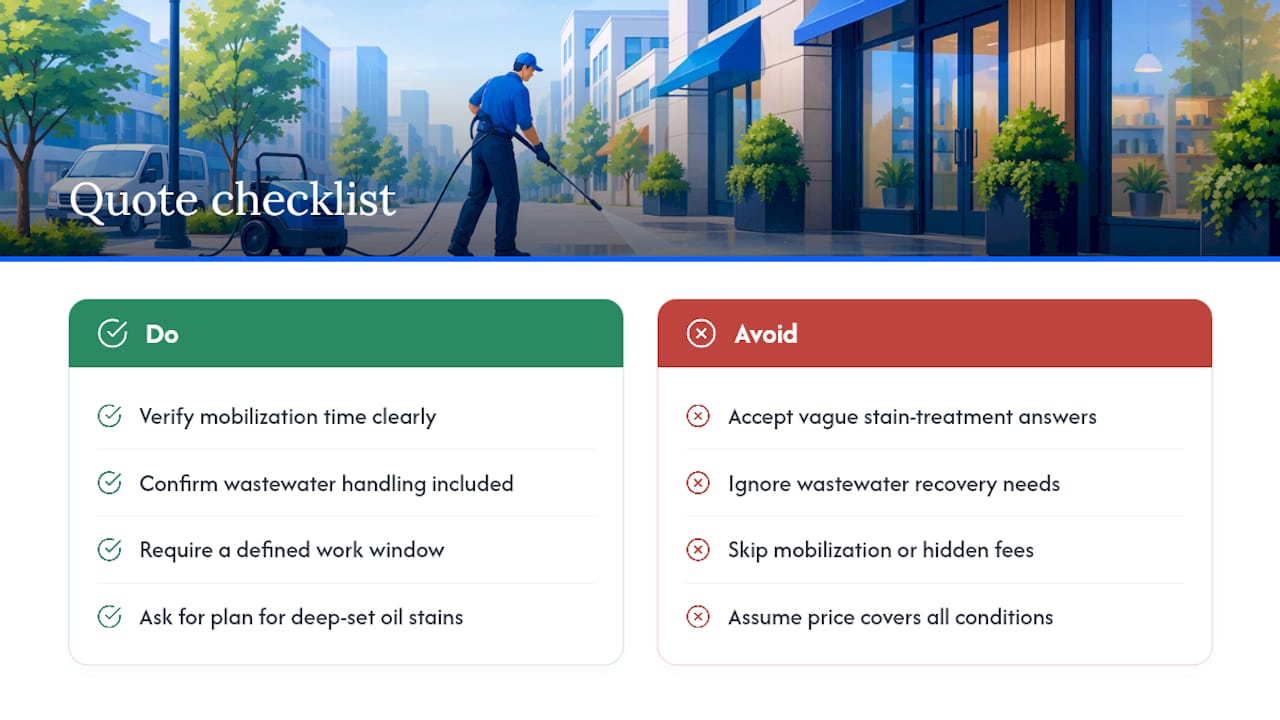
- Exact frontage measured in linear footage or square footage, not eyeballed from a drive-by
- Annotated photos marking gum, grease, deep oil stains, and rust separately
- Whether hot water and degreasers are included, and for which zones
- The wastewater handling method: containment, filtration, or municipal discharge
- Water source and access, plus crew mobilization time built into the quote
- Proposed work window (before-open, after-close, or a negotiated slot)
- Certificate of insurance available on request, along with stormwater practices
- Before-and-after photo reporting as a standard deliverable
- Written change-order rules for anything discovered once work starts
Pro Tip: A proper quote comes from an on-site walkthrough, not a photo review. Drainage slope, surface type, and how deep the grease has soaked in all change the scope, and a contractor who skips the walkthrough is guessing at your price.
Providers who work retail properties regularly build this level of detail into a standard storefront cleaning scope, which is worth using as your baseline when you compare bids.
How Much Does Storefront Sidewalk Cleaning Cost?
Market examples for sidewalk-only cleaning commonly land within a moderate price range per square foot, but actual costs vary and require a site-specific quote.
Area is only the starting point. Grease concentration, gum density, access to water, the need for traffic control, and wastewater recovery all move the number up from there. A clean strip mall sidewalk and a grease-streaked restaurant pad of the same square footage are not the same job, even though they’d look identical on a spreadsheet that only tracks square feet.
Read a quote for what it leaves out, not just what it includes. A bid that skips mobilization time, wastewater handling, or a defined work window is often a lowball that turns into change orders once the crew shows up. Ask what happens if they find deep-set oil stains not visible from the sidewalk. If the answer is vague, the price probably is too.
How Often Should You Clean a Storefront Sidewalk?
Frequency should track soil load, not a calendar habit borrowed from another property. A drive-thru or restaurant entrance accumulating grease and food residue daily needs monthly attention at minimum, sometimes more in summer when heat accelerates staining. General retail without heavy food traffic usually holds up fine on a quarterly or biannual schedule.
- Monthly: restaurants, drive-thrus, and any grease-prone entrance
- Quarterly to biannual: general retail storefronts with moderate foot traffic
- Custom cycles: plazas and business improvement districts with mixed tenant use
- Recurring plans: prevent the buildup that turns a cleaning job into a restoration job
Multi-tenant centers have a coordination problem unique to them. One clean storefront next to three grimy ones looks worse than a uniformly average center, so recurring contract scheduling across all tenants keeps the whole property looking consistent instead of patchy.
What to Verify Before Hiring a Storefront Cleaning Crew
Commercial-grade equipment matters because consumer pressure washers can’t generate the sustained hot water output that grease removal demands, and insured crews matter because a slip-and-fall claim on your property without contractor coverage becomes your liability. All Day Power Washing advertises both, along with same-week quotes and a satisfaction guarantee, which are the baseline signals worth confirming with any provider you’re evaluating.
Before you sign off on a contractor, verify these deliverables:
- A certificate of insurance provided on request, not just claimed in marketing copy
- Before-and-after photo documentation for your maintenance records
- A written scope that names exactly what’s included and excluded
- A documented wastewater handling method, especially near storm drains
An Editorial Note on Getting This Right
Most managers treat sidewalk cleaning as a one-time fix instead of a recurring line item, and that’s backward. A quarterly plan costs less over a year than emergency deep cleans after a complaint, and it keeps you ahead of the slip-and-fall problem instead of reacting to it. Get the scope and wastewater plan in writing before the crew shows up. Verbal promises don’t hold up when a storm drain gets flagged.
— Brandon
Get a Same-Week Quote for Your Storefront
Professional storefront cleaning services typically cover storefront and sidewalk cleaning, hot-water degreasing for grease-prone entries, gum removal that avoids damage to concrete, and recurring plans that maintain consistent appearance across multi-tenant properties.

Every job comes from commercial-grade equipment run by insured crews, backed by a satisfaction guarantee and same-week quotes so you’re not waiting weeks to get a hazard fixed. If your storefront is in the Colorado Springs or Denver area, request a free quote through All Day Power Washing and get an on-site assessment scheduled before your next slip complaint turns into a claim.
FAQ
What Is the Average Cost to Pressure Wash a Sidewalk?
Market examples for sidewalk-only cleaning run roughly $0.10 to $0.25 per square foot, but that figure is a benchmark, not a guarantee. Grease concentration, gum density, and access to water all push the final quote up or down, so get a site-specific quote before budgeting.
What Is the Best Way to Clean a Concrete Sidewalk?
Hot water paired with a surface cleaner handles most concrete sidewalks evenly without the streaking a handheld wand leaves behind. Grease and gum need targeted treatment first, either degreaser or controlled heat, and soft-wash chemistry protects any adjacent pavers or masonry.
Are There Rules for Cleaning Sidewalks and Handling Runoff?
Local stormwater and MS4 programs often require detergent or grease-laden runoff to be contained, filtered, or recovered rather than sent into a storm drain, and rules vary by municipality. OSHA’s walking-working surfaces standard separately requires walkways be kept clean and hazard-free, which is the safety side of the same maintenance obligation.
What Is the Best Cleaning Solution for a Storefront Sidewalk?
There’s no single solution that fits every stain. Hot water and degreaser handle grease and drive-thru buildup, soft-wash chemistry protects delicate surfaces like brick and pavers, and heat-based gum removal lifts residue without pitting the concrete underneath.
How Often Should a Commercial Sidewalk Be Cleaned?
Restaurants and drive-thrus with heavy grease exposure generally need monthly cleaning, while general retail storefronts hold up on a quarterly or biannual schedule. Plazas and multi-tenant centers often need custom cycles to keep every storefront looking consistent.